

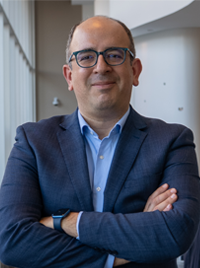
Nader Ghasemlou, PhD, is a Senior Scientist at the Krembil Brain Institute and Associate Professor at the University of Toronto with appointments in the Departments of Immunology and Anesthesiology & Pain Medicine. He leads the Pain Chronobiology & Neuroimmunology Laboratory, studying changes in both preclinical and clinical diseases of the nervous system. After completing his BSc and MSc at Queen’s University, Dr Ghasemlou joined Dr Samuel David’s lab for his PhD at McGill University where he studied the impact of neuroinflammation in spinal cord injury. He was then awarded a CIHR Banting Fellowship for his postdoctoral work in the laboratory of Dr Clifford Woolf at Harvard Medical School and Boston Children’s Hospital. Here, he examined the contribution of bidirectional communication between peripheral immune cells and sensory neurons to the development of acute and chronic pain. His team now uses circadian rhythmicity and time-of-day effects as a tool to better define neuroimmune outcomes.

The Pain Chronobiology & Neuroimmunology Laboratory is working to better understand how the nervous and immune systems communicate to cause diseases of the nervous system, including pain, spinal cord injury, and multiple sclerosis. All organs (apart from the brain) are densely innervated with sensory neuron, serving to sense damage and external stimuli, and are also populated by resident and circulating immune cells, that respond to injury and disease. 

Translational circadian medicine: Bridging the gap between the laboratory and clinic is a major focus of our work. Using ecological momentary assessment (e-diary), longitudinal tissue collection, and multi-omic analyses, our team seeks to define changes at the person-level in both health and disease. This strategy of personalized and precision medicine can be used to create new treatment strategies that may help “reset" the body’s misaligned internal clocks. 

Circadian neuroimmunology: Communication between the nervous and immune systems can both exacerbate and reduce damage, depending on the injury or disease. To further complicate matters, these two critical physiological systems are regulated by circadian (or 24-hour) rhythms at the molecular, cellular, and systems levels. Here, we are studying how communication between resident and recruited immune cells are affected by individual molecular clocks as well as time-of-day changes. 

Gut-CNS axis: The gut serves as the largest reservoir of peripheral immune cells, where they encounter the resident microbiome. The communication between immune cells and "gut bugs” can polarize these cells towards either pro- or anti-inflammatory phenotypes. We are working to understand whether cells in the gut can alter the central nervous system, particularly in spinal cord injury and multiple sclerosis. 

For a list of Dr. Ghasemlou's publications, please visit PubMed or ORCID.


Associate Professor, Department of Immunology, University of Toronto
Associate Professor, Department of Anesthesiology & Pain Medicine, University of Toronto