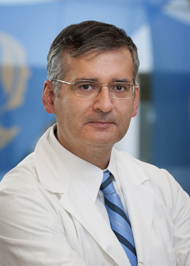
Dr. Lozano's research focuses on Functional Neurosurgery and the development of novel therapies for movement disorders and psychiatric disease. His lab studies brain mapping, deep brain stimulation (DBS) and focused ultrasound (FUS) in patients and in animal models of disease. His lab has approximately 850 publications and ranks first globally in total citations in the field of deep brain stimulation. Dr. Lozano is the most cited neurosurgeon in the world (Clarivate). He has been involved in phase I “first in man” applications of DBS in dystonia, Huntington’s, depression, anorexia and Alzheimer disease, and has been involved in phase II and III trials of DBS and brain intraparenchymal drug delivery in patients with Parkinson disease and other neurological disorders. His recent work in experimental animals has shown that DBS can drive neurogenesis and enhance memory function. Dr. Lozano serves as Editor-in-Chief of Stereotactic and Functional Neurosurgery.
Deep brain stimulation: current challenges and future directions
Study Status: completed
Institute: Krembil Research Institute
Study Purpose: Deep brain stimulation (DBS) is a big medical breakthrough from the last 20 years. It's a type of surgery that can check how the brain is working and give small electric shocks to help treat brain and mood disorders. This review talks about how DBS has helped us learn more about brain disorders and what the main challenges and future goals are for DBS research. Understanding these next steps will help make DBS even better for treating difficult brain disorders.
Background: Deep brain stimulation (DBS) is a strong tool used to help treat brain diseases and learn how they work. DBS helps doctors understand more about how problems in the brain can cause different disorders. Even though DBS works well and is used a lot, there are still some important questions. For example, doctors need to figure out which parts of the brain to target and which patients will benefit the most.
Study Methods: From 2002 to 2011, over 30,000 DBS surgeries were done in the US. The FDA has approved DBS for Parkinson's disease, dystonia, and essential tremor. Scientists are studying DBS for depression and obsessive-compulsive disorder (OCD). Early results are good. A study on DBS for mild Alzheimer's disease didn't show big improvements in memory, but older patients did seem to get some benefit. Researchers are still figuring out which Alzheimer's patients might get better with DBS.
Key Findings: We still don't know exactly how DBS works, so more research is needed. Using DBS for new types of patients and problems needs careful thought about what is right and fair.
DBS has been successful because of studies that show how it works and affects the brain. There are still many ways to make DBS better, like making it more efficient and comfortable, using better imaging and other tools, and sharing worldwide experiences with better study designs. Even though DBS is still developing, the main goal is to treat brain diseases safely and effectively.
Health Conditions:
Neurology & Neurosurgery (Parkinson's, epilepsy, Alzheimer's, etc.)
Why so much fuss about focused ultrasound thalamotomy for essential tremor
Study Status: completed
Institute: Krembil Research Institute
Study Purpose: Focused ultrasound (FUS) was approved in by Health Canada in 2016 to treat essential tremor (ET), which causes shaking that you can't control. FUS treatment is offered at Toronto Western Hospital along with a number of other treatment options such as Deep Brain Stimulation (DBS).
This study looked at how much FUS is being used for ET across the world and why patients are choosing it.
Background: New technologies usually become popular in stages: first by innovators and early adopters, then by the early majority, followed by the majority, and lastly, non-adopters. How quickly and widely a new technology is used depends on how well it works, its benefits over other options, cost, availability, ease of use, and marketing efforts. Surgery for movement disorders, like deep brain stimulation (DBS), involves a lot of technology and has seen many important innovations.
Understanding why a specific technology is adopted can help identify major breakthroughs and protect patients and the health system from unproven treatments. We believe that the development of focused ultrasound (FUS) has renewed interest in lesioning procedures compared to DBS. The adoption of FUS is faster and more widespread than similar methods like Gamma Knife (GK).
Study Methods: We (neurosurgeons) checked three things to see how FUS and other surgeries for ET are being used:
1. How many times different ET treatments were talked about at big medical meetings.
2. How many research papers were written about each treatment.
3. How many thalamotomy surgeries (a type of brain surgery) were done around the world for ET, using information from companies that make the surgery tools.
Key Findings: We found the following:
1. There are more talks about FUS and other lesioning procedures compared to deep brain stimulation (DBS) at medical meetings.
2. There are more research papers on FUS (93) than on stereotactic radiosurgery (SRS) (68) or radiofrequency (43) for ET, but DBS still has the most papers (750).
3. In 2019, more than 1,200 FUS thalamotomies were done in 44 centers, more than the 342 Gamma Knife units in 2018, but still fewer than the over 2,400 DBS surgeries for ET each year.
FUS is becoming a popular treatment for ET. People might like it because it is has a lower burden for patient, it lets doctors check how well it's working during the procedure, it gives immediate results, and it is well advertised.
Health Conditions:
Neurology & Neurosurgery (Parkinson's, epilepsy, Alzheimer's, etc.)
Predicting the best deep brain stimulation parameters for Parkinson's disease using functional MRI and machine learning
Study Status: active
Institute: Krembil Research Institute
Study Purpose: Deep brain stimulation helps people with Parkinson's disease feel better when the settings are just right. Finding the best settings for deep brain stimulation is known as programming. It is often done by trial and error and based on what the doctor observes and their experience. This means that finding the best settings can take a lot of visits to the doctor. This study looks at whether a brain scan and machine learning can help predict the best deep brain stimulation settings for each person.
Background: Deep brain stimulation is a common treatment for movement disorders like Parkinson’s disease. It works by placing an electrode in the brain to deliver electrical stimulation. This helps correct abnormal brain activity. New brain imaging techniques, like functional magnetic resonance imaging (fMRI), have helped us learn more about how deep brain stimulation affects brain activity. Previously, we analyzed the brain scans of 67 Parkinson’s disease patients with both good and not-so-good deep brain stimulation settings. We found that the best settings made a unique pattern in the brain, especially in the part that controls movement. We used this pattern and data from 39 patients who had already had their deep brain stimulation settings optimized, to create a computer program that could tell if the settings were good or not. The computer program was 88% accurate. We tested this program on new groups of patients, including some who had never had deep brain stimulation before, and it worked well. This means fMRI scans could help find the best deep brain stimulation settings without as many doctor visits.
Study Methods: We plan to enroll 200 Parkinson’s disease patients who have had deep brain stimulation to participate in this study. Once participants have provided their consent to participate in the study, they complete two fMRI sessions. In each session, magnetic waves are used to take pictures of the brain and brain activity. The two sessions are scheduled at least one week apart and are two hours each. Each session involves being scanned in the fMRI while their deep brain stimulation settings are kept at good settings and then again when they were set to not-so-good deep brain stimulation settings. So far 67 patients have completed the study already and these early results were published in the research journal Nature Communications (See the External Links section for more information).
Health Conditions:
Neurology & Neurosurgery (Parkinson's, epilepsy, Alzheimer's, etc.)
External Links:
- Alan & Susan Hudson Cornerstone Chair in Neurosurgery, UHN
- University Professor, Department of Surgery, University of Toronto