Meet Dr. Razq Hakem @PMResearch
Turning family loss into lifesaving BRCA discoveries.
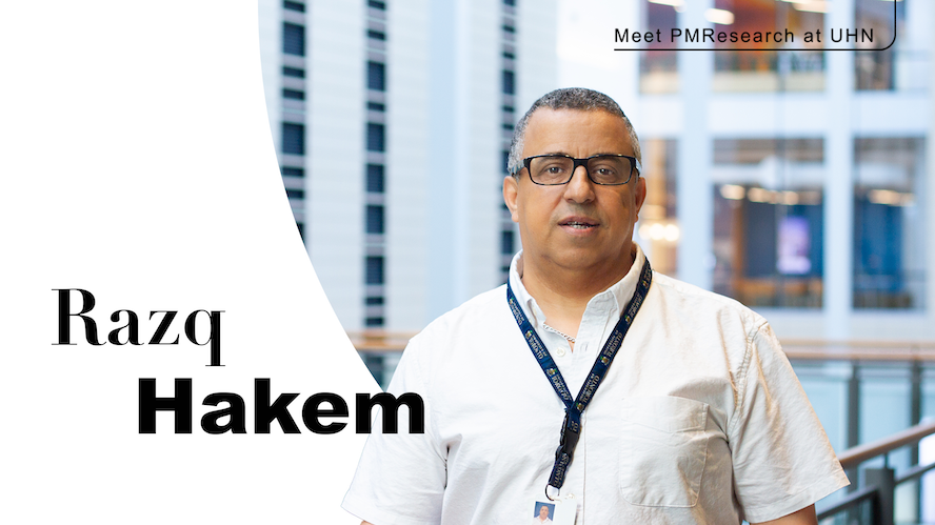
Dr. Razq Hakem is a Senior Scientist and the Lee K. and Margaret Lau Chair in Breast Cancer Research at UHN’s Princess Margaret Cancer Centre.
As a teenager in his home country, Morocco, Razq Hakem watched his grandmother suffer from an agonizing disease.
His family tried to shield him from the sadness of the situation. Years later, he learned she died of ovarian cancer.
While completing his PhD in France at the University of Aix-Marseille II, he also found out that two aunts and other relatives had developed aggressive breast cancers at unusually young ages.
“I didn’t know what subtype of cancer they had,” he recalls, “but it was similar to BRCA1-mutated cancer, which is also my research focus.”
These early encounters planted the seeds of a lifelong mission: to understand the genetic roots of cancer and to find ways to stop it.
Today, Dr. Razq Hakem is a Senior Scientist and the Lee K. and Margaret Lau Chair in Breast Cancer Research at UHN’s Princess Margaret Cancer Centre, recognized globally for his breakthrough work on BRCA1 and BRCA2 mutations and DNA repair mechanisms.
Discovering BRCA’s role in breast cancer
In the 1990s, scientists recognized that women carrying mutations on the BRCA1 or BRCA2 genes had higher risks for cancer, but they lacked conclusive evidence linking the loss of these genes to specific cancers.
At that time, Razq had completed a PhD in immunology in France and a postdoctoral training program in immunology and genetics in the U.S. He arrived in Toronto in September 1994 to study the roles of BRCA genes in preclinical models and to uncover how their mutations are associated with cancer.
“Several top-tier laboratories were racing to publish the earliest discoveries related to BRCA1 mutations,” Razq remembers the fierce competition, and he was undeterred.
He deleted the BRCA1 gene in lab models, and the effects were detrimental. The team discovered that the loss of BRCA1 results in DNA damage, cell cycle arrest, and halted proliferation, rendering cells unable to survive.
Despite the exciting finding, Razq was frustrated as he could not study BRCA1 associated cancers, given that the cells in the lab models were dying prematurely. Therefore, he modified his experiments and deleted BRCA1 only in the mammary glands. After the modification, He observed a high incidence of mammary tumours, clearly indicating that the BRCA1 gene suppresses tumour growth in breast tissue, and that its mutations predispose for breast cancer.
He published these landmark results in Cell in 1996, and Genes & Development in 2004, followed by a series of studies that altered the global research focus toward understanding BRCA1’s role in DNA damage repair, replication stress and tumour suppression, which paved the way for targeted therapies.
“We were among the first groups worldwide to demonstrate the harmful effects of BRCA mutations and their link to breast cancer in preclinical models,” says Razq. “I am very proud of our achievements and grateful to our national and international collaborators.”
Therapy development from BRCA research
Razq’s lab has identified several potential therapeutic targets for treating cancers associated with BRCA1 and BRCA2 mutations, two of which, RNF 8 and RNF168, are moving along the drug development pipeline.
His lab showed that loss of RNF 8 or RNF168 genes can inhibit breast and ovarian tumour development in preclinical models with BRCA mutations. They also revealed the underlying molecular mechanisms, involving the accumulation of DNA–RNA hybrids (R-loops), increased cell replication stress and genomic instability that can eventually lead to the death of BRCA-mutant cancers.
“Currently, BRCA-associated cancers are treated with different approaches, including PARP inhibitors and Platinum-based compounds. However, patients can develop resistance to these therapies, and there’s a need to come up with new treatments. Our discoveries point to novel strategies that can bring hope to those patients.”
The team also discovered a novel DNA repair mechanism that provided new insights for treating BRCA1-deficient cancers, in a collaboration with Dr. Karim Mekhail, a professor of laboratory medicine and pathobiology at the University of Toronto’s Temerty Faculty of Medicine.
They found that microtubule filaments from the cell cytoplasm can push the envelope of the cell nucleus, triggering tiny tubules to reach the DNA inside and catch most double-stranded breaks. BRCA1 mutant cells rely heavily on this mechanism to proliferate, and the team is trying to exploit this vulnerability to stop cancer growth.
A mission born from loss
Razq did not know what disease his grandmother had. His family tried to shield him from the sadness of the situation. Only years later, he learned she died of ovarian cancer.
This experience not only sparked his interest in cancer research but also in advocating for cancer awareness, especially in communities where cancer remains a taboo subject. “Times are different now—there is improvement in how we treat metastatic cancers, more knowledge of what genes are linked to cancer, and new ways to detect it,” he reflects.
“Keeping it hidden is dangerous,” he says. “Being informed can save lives.”
He remembers his grandmother’s suffering, the quiet agony behind closed doors. That memory reminds him that his work is never abstract. It is about real people, real families.
Razq recalls riding hospital elevators for work, surrounded by patients or families visiting loved ones. He recognizes the look of pain and the weight of fear. “They might be suffering because their parents or family members were at high risk of not surviving the cancer. That drives me to keep working every day.”
Meet PMResearch is a story series that features Princess Margaret researchers. It showcases the research of world-class scientists, as well as their passions and interests in career and life—from hobbies and avocations to career trajectories and life philosophies. The researchers that we select are relevant to advocacy/awareness initiatives or have recently received awards or published papers. We are also showcasing the diversity of our staff in keeping with UHN themes and priorities.