Francesco @TeamUHN
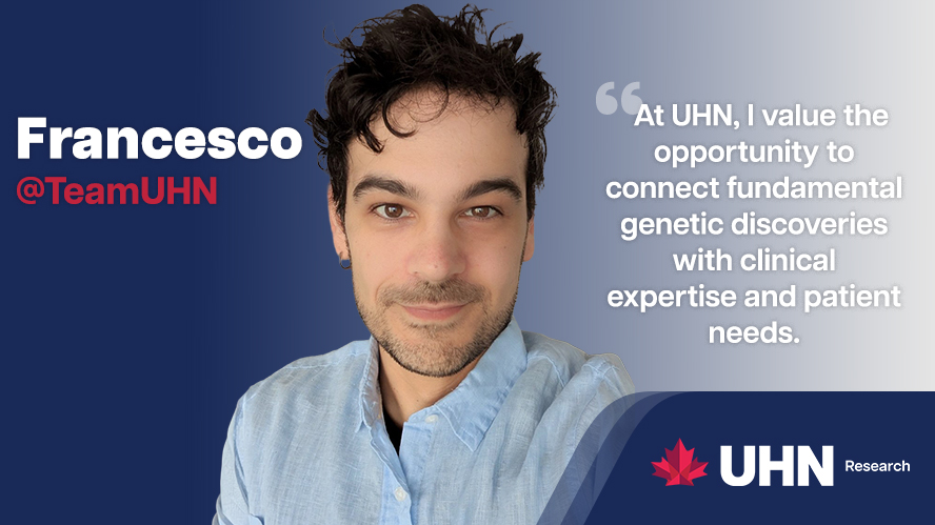
Dr. Francesco Rugolo is a Postdoctoral Researcher at UHN.
Tell us about your role at UHN.
I am a Postdoctoral Researcher in Dr. Moumita Barua’s lab at UHN’s Organ Systems & Integrated Health Sciences Research Institute. My research combines molecular and cellular biology, experimental models, and genomic and bioinformatics analyses to investigate the mechanisms underlying genetic kidney disorders.
How long have you been in this role?
I have been in the Barua lab since July 2025. Before joining the lab, I held my first Postdoctoral Researcher position in Dr. Tak Mak’s lab at UHN’s Princess Margaret Cancer Centre, studying how a specific signalling molecule from immune cells regulates skin inflammation, tumour development, and liver regeneration. I completed my PhD in Biochemistry and Molecular Biology from the University of Rome Tor Vergata, where my research examined how the metabolism of fats and the regulation of gene expression influence cancer development and cell differentiation, including the identification of a prognostic marker for neuroblastoma.
What are you working on at UHN?
At UHN, I am studying the molecular mechanisms of genetic kidney disorders, with a particular focus on the repair of the tiny filtering units of the kidney, called glomeruli, and the regeneration of podocytes—specialized kidney cells that form a barrier for blood filtration. I am also working on identifying potential biomarkers and therapeutic targets of kidney disorders.
What are you passionate about in your role at UHN? What does health research mean to you?
What excites me most about working at UHN is being in an environment where fundamental biological questions remain closely connected to patients and their needs. Our work begins with a simple but important question: when the kidney is damaged, what mechanisms support its repair, and how can proper function be restored?
I especially enjoy moving between laboratory experiments and complex datasets, following small clues until they begin to reveal a larger biological story. To me, health research means pursuing those clues with curiosity and rigour until they can improve our understanding of disease and how we treat it.
What makes UHN an ideal place to advance health research?
UHN is an ideal place to advance health research because you have the opportunity to work and collaborate with people who have different experience and expertise. UHN brings together world-leading scientists, clinicians, trainees, and patients within a highly collaborative research hospital network. I particularly value the opportunity to connect fundamental genetic discoveries with clinical expertise and patient needs, helping accelerate the translation of research findings into improved diagnosis, treatment, and care.
UHN’s multidisciplinary environment, advanced research infrastructure, and strong culture of innovation provide the resources and partnerships needed to address complex health challenges.
How does your work help to advance UHN's vision of A Healthier World?
My work contributes to UHN’s vision of A Healthier World by trying to understand why the kidney loses its ability to repair itself and whether that capacity can be restored. In the Barua Lab, we study how the gene PAX2 (Paired box gene 2) and related molecular pathways influence podocyte regeneration and the progression of genetic glomerular disease.
By combining experimental models with genomic data, we hope to uncover mechanisms that could lead to better biomarkers and, eventually, new therapeutic strategies. For me, advancing A Healthier World means turning discoveries at the bench into possibilities that could one day improve the lives of people living with kidney disease.
Do you have any interests outside of work?
Outside of science, I enjoy playing video games and reading books—I think of these as “active” hobbies because they require active engagement. If you fall asleep during a movie, it continues without you, but a book or video game cannot move forward unless you are engaged.
Over the past few years, I have also become increasingly interested in experimenting with new AI tools. AI has changed the way I approach everyday problems: when I need something, my first instinct is now to see whether I can build it myself, and I often enjoy the process of creating it as much as the final result.
What do you see for the future of health research, and what gets you excited about it?
I see the integration of AI with biology and health research as one of the greatest opportunities we have had in recent decades to advance our understanding of human health and disease. AI can help us identify patterns across complex genetic, molecular, and clinical data that would be difficult to recognize through traditional approaches alone. What excites me most is its potential to not only make research faster, but help us ask better questions and uncover connections that we might otherwise miss. I believe the greatest advances will come from combining these capabilities with biological expertise, rigorous experimentation, and a clear focus on meaningful outcomes for patients.
How to Participate in You @TeamUHN
You @TeamUHN is a campaign to highlight the important scientific contributions that research lab staff, trainees and learners, administrative staff, core facilities staff, Research Solutions & Services staff, and volunteers make towards A Healthier World through discovery and innovation. If you’re interested in sharing your story, we invite you to complete this form here(link is external) (Open to UHN staff, trainees, and volunteers).