Understanding Spine Surgery Outcomes
Study finds overall osteoarthritis burden may influence recovery after lumbar spine surgery.
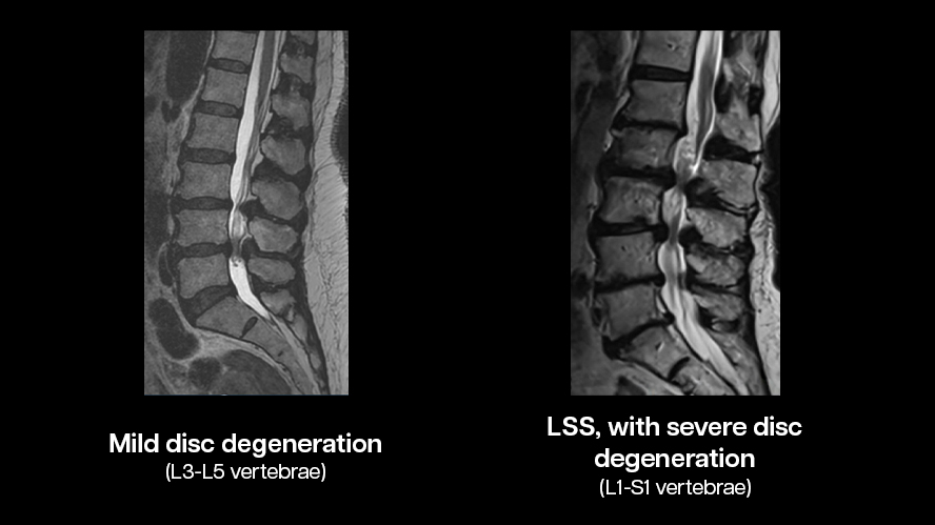
Osteoarthritis (OA) affects nearly 15% of all Canadians. Although OA in the spine is common, most research is focused on OA in appendage joints, such as knees, hands, and hips. For those with spinal OA, the symptoms can be debilitating, seriously impairing quality of life. (Original images c/o UHN's Schroeder Arthritis Institute)
New research from UHN's Schroeder Arthritis Institute suggests that patients with more extensive lumbar disc degeneration may be less likely to benefit from surgery for lumbar spinal stenosis, a narrowing of the spinal canal in the lower back, caused by osteoarthritis (LSS-OA). The findings could help surgeons and patients make more informed treatment decisions and set realistic expectations before surgery.
LSS occurs when osteoarthritis and age-related changes in the spine narrow the space around nerves in the lower back, causing symptoms such as pain, numbness, weakness, and difficulty walking. Surgery is designed to decompress the spine and relieve pressure on these nerves. However, up to 40% of patients do not experience meaningful improvement after surgery.
To better understand this disparity in outcomes, the researchers analyzed data from 119 patients who underwent surgery for LSS-OA. Using MRI scans, the team assessed the extent of disc degeneration throughout each patient's lumbar spine. Before surgery and one year afterward, patients’ pain scores and level of disability were assessed through various questionnaire-style assessments. Participants also self-reported OA symptoms in other joints.
Dr. Raja Rampersaud, the first author of this study, and his colleagues found that about 25% of patients had a high burden of lumbar disc degeneration. Of these patients, only 50% achieved a clinically meaningful improvement in disability after surgery. In contrast, nearly 75% of patients with lower levels of degeneration achieved meaningful improvement.
The study also showed that many patients experienced symptoms beyond the spine. More than half reported pain or stiffness in at least three other joint sites, such as the hips, knees, hands, or feet. Patients with greater joint involvement experienced less improvement after surgery.
Together, the findings suggest that surgical outcomes may depend on both the condition of the surgical site and the overall burden of OA throughout the spine and the rest of the body. A more comprehensive view of OA and musculoskeletal health could support more personalized treatment planning and improve outcomes for those living with LSS-OA.
Dr. Raja Rampersaud, Krembil Clinician Investigator at UHN’s Schroeder Arthritis Institute and Professor in the Department of Surgery at the University of Toronto’s Temerty Faculty of Medicine, is the first author.
Dr. Anthony Perruccio, Senior Scientist at UHN’s Schroeder Arthritis Institute, is the senior author. He is also a Professor at the University of Toronto’s Institute of Health Policy, Management and Evaluation (IHPME), Dalla Lana School of Public Health, and Temerty Faculty of Medicine Department of Surgery.
This work was supported by the J. Bernard Gosevitz Chair in Arthritis Research and UHN Foundation. Dr. Perruccio was supported directly by an award from the Arthritis Society Canada.
Dr. Rampersaud receives royalties from Medtronic outside of the work in this study, and Dr. Kapoor is an Executive Board Member, Treasurer, and President-Elect of the Osteoarthritis Research Society International (OARSI) as well as a Scientific Advisory Board Member for Chiron Inc.
Rampersaud YR, Power JD, Nahanni C, Fine N, Canizares M, Kapoor M, Perruccio AV. The impact of overall lumbar disc degeneration burden on disability outcomes following surgery for lumbar spinal stenosis due to osteoarthritis. Osteoarthr Cartil Open. DOI: 10.1016/j.ocarto.2026.100766.