The Science Behind Safer Eating
Testing different food textures can support better care for people living with dysphagia.
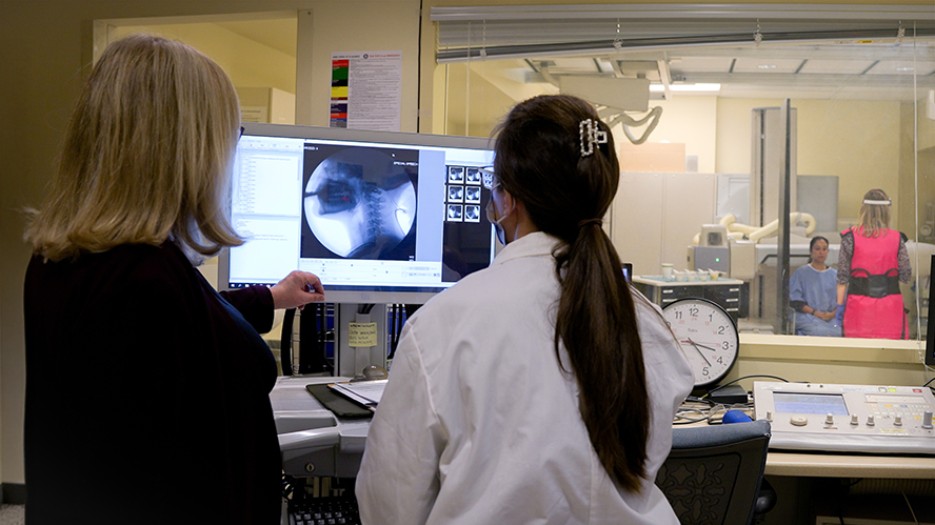
Prof. Catriona Steele, senior author of the study, pictured here analyzing a videofluoroscopy recording. This technique allows clinicians to observe swallowing in real time and gain insights to better guide dysphagia care.
People with swallowing difficulties, known as dysphagia, often rely on texture-modified foods, such as purées and thick liquids, to make eating safer and easier. However, these changes can reduce nutritional value and enjoyment, highlighting the need to reassess current dietary recommendations. Researchers from UHN’s KITE Research Institute found that different food textures can influence measures of swallowing timing and efficiency, offering new data to inform clinical assessments and care.
Using videofluoroscopy—a moving X-ray that shows how food travels through the throat in real time—the research team studied 20 healthy adults as they ate foods of different textures, as defined by the International Dysphagia Diet Standardisation Initiative: minced and moist, soft and bite-sized, and regular solid food. The team measured how quickly the food moved through the throat, how effectively the throat muscles worked, and how much food was left behind (residue). They also assessed safety by checking whether any food entered the airway.
The findings showed that swallowing performance changed with texture. Foods with larger particles that required more chewing moved through the throat more slowly. Minced and moist foods moved the fastest, followed by soft and bite-sized foods, and then regular solids. Residue left behind after swallowing was highest for minced and moist and regular solids, and lowest for soft and bite-sized foods. Regardless of food texture, all participants swallowed safely, with no food entering the airway.
Importantly, the findings showed that evaluations of swallowing with thick liquids and purées are insufficient to predict how a person will swallow food. These smoother textures do not reflect how people eat in everyday life. This is a key finding as current assessments do not always include food. The researchers recommend that a solid food item, like a cracker, be routinely included in swallowing assessments to fully understand a person’s swallowing efficiency and muscle function.
Overall, the study suggests that solid food should be included in swallowing assessments to inform optimal diet texture recommendations. Although further research is needed in clinical populations, these findings may help guide more balanced approaches to dysphagia management that support safety and quality of life.
Pooja Gandhi, first author of the study, was a former PhD student in the lab of Prof. Catriona Steele. She is currently an Assistant Professor in the Department of Communication Sciences and Disorders at the University of Alberta.
Prof. Catriona Steele, senior author of the study, is a Senior Scientist at UHN’s KITE Research Institute and a Tier 1 Canada Research Chair in Swallowing and Food Oral Processing. She is also a Professor in the Department of Speech-Language Pathology and a Faculty Member of the Rehabilitation Sciences Institute at the University of Toronto
This work was supported by UHN Foundation, the National Institute on Deafness and Other Communication Disorders, and the National Institute on Aging.
Prof. Steele is the developer of the ASPEKT Method of videofluoroscopy analysis, which was used in this study. She was also a board member of the International Dysphagia Diet Standardisation Initiative from 2012 to 2023.
Gandhi P, Barrett E, Mancopes R, Panes V, Peladeau-Pigeon M, Simmons MM, Steele CM. What About Foods? The Influence of Food Texture on the Safety, Timing, Kinematics, and Efficiency of Pharyngeal Phase Swallowing in Healthy Adults. J Speech Lang Hear Res. 2026 Apr 10. doi: 10.1044/2025_JSLHR-25-00546.