Drug Discovery with AI and Robotics
UHN study unveils an AI and robotics-driven lab that can enhance molecular discovery.
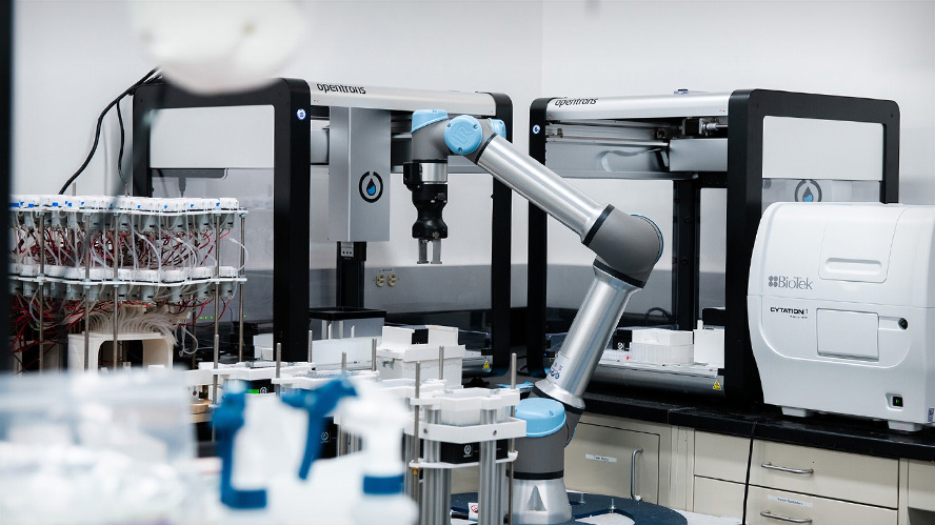
Self-driving labs, like the LUMI-lab, are a combination of AI and advanced robotics that are able to rapidly test new molecules or materials. The LUMI‑lab system, pictured, integrates a pre‑trained AI model, decision‑making software, and a suite of coordinated robotic and laboratory automation tools. (Image: Steven Southon)
New research from UHN, published in Cell, unveils a “self-driving” laboratory that uses AI and robotics to accelerate the discovery of molecules for next-generation medicines. This system, called LUMI-lab, could transform drug discovery and advance RNA-based treatments such as gene‑editing therapies and mRNA‑based vaccines.
Identifying and analyzing molecules for drug discovery is a time-intensive and challenging process. With an infinite number of possible small molecules and chemical compounds, researchers currently lack efficient ways to systematically search and test new effective treatments.
Self-driving laboratories (SDLs) combine AI and advanced robotic automation to rapidly test new molecules, emerging as a potentially powerful tool for drug discovery. However, building SDLs is difficult in newer research areas, where there is limited historical, well-labelled data to train AI models.
To address this, UHN researchers developed an SDL system known as LUMI-lab (Large-scale Unsupervised Modelling followed by Iterative experiments), designed to run automated laboratory processes and investigate chemicals for drug discovery.
At the core of this system is the LUMI-model, an AI foundation model that acts as the "brain" of LUMI-lab. Foundation models are trained on large amounts of diverse, often unlabelled data to learn patterns. LUMI-lab is pretrained on over 28 million molecular structures to learn general patterns that link molecular structure to function. Once trained, the LUMI-model is able to recommend and prioritize the most promising candidates for testing, translating these decisions into actions for the robotic laboratory equipment to carry out.
The research team applied this system to analyze over 1,700 lipid nanoparticles (LNPs)—tiny, lipid-based delivery molecules—and determine how effectively they can deliver genetic material, like mRNA, into cells. Developing more effective LNPs is critical to advancing RNA-based therapies, such as mRNA vaccines and gene-editing therapies. Designing better LNPs is difficult because of the lack of historical data.
LUMI-lab found that LNPs with brominated lipids—lipids modified to include bromine atoms in their tail—were better at delivering mRNA into human lung cells. One such brominated lipid, named LUMI-6, was particularly effective, as LNPs made with LUMI-6 efficiently delivered gene editing tools into lung cells, achieving over 20% gene-editing efficiency.
This work highlights the potential power of AI-driven robotic systems to advance molecular discovery, even when data is limited. Systems like LUMI-lab could transform how scientists discover and optimize molecules for a wide range of applications, from gene therapies to vaccines and beyond.
For a video of LUMI-lab in action, click here.
Dr. Yue Xu was a Postdoctoral Researcher in Dr. Li’s lab at the time of this study. He is currently an Instructor at Baylor College of Medicine. He is the co-first author of the study.
Dr. Haotian Cui, a former Postdoctoral Researcher in Dr. Bo Wang and Bowen Li’s lab, is the co-first author of the study. He is currently a Senior AI Scientist at Xaira Therapeutics.
Dr. Bo Wang is the Chief AI Scientist and a Senior Scientist at UHN. He is also an Associate Professor in the Departments of Laboratory Medicine & Pathology and Computer Science at the University of Toronto. He is co-senior author of the study.
Dr. Bowen Li, Affiliate Scientist at UHN’s Princess Margaret Cancer Centre and Assistant Professor at the Leslie Dan Faculty of Pharmacy at the University of Toronto, is co-senior author of the study.
This work was supported by the Acceleration Consortium, the Leslie Dan Faculty of Pharmacy, the Canadian Institutes of Health Research, the J.P. Bickell Foundation, the Natural Sciences and Engineering Research Council of Canada, the Canada Foundation for Innovation, the Connaught Fund, the Government of Canada National Institutes of Health, and The Princess Margaret Cancer Foundation.
Dr. Li is a Tier 2 Canada Research Chair in RNA Vaccines and Therapeutics. He is also the GSK Chair in Pharmaceutics and Drug Delivery.
Drs. Yue Xu, Haotian Cui, Bo Wang, and Bowen Li have filed a patent for LUMI-lab, including the model and ionizable lipids. Dr. Wang serves as a scientific advisor to Shift Bioscience, Deep Genomics, and Vevo Therapeutics and acts as a consultant for Arsenal Bioscience.
Xu Y, Cui H, Pang K, Li G, Gong F, Dong S, Wang B, Li B. LUMI-lab: A foundation model-driven autonomous platform enabling discovery of ionizable lipid designs for mRNA delivery. Cell. 2026 Mar 19;189(6):1620-1635.e25. doi: 10.1016/j.cell.2026.01.012. Epub 2026 Feb 24.