Meet Dr. Benjamin Haibe-Kains @PMResearch
Making AI research transparent for a safe health care system
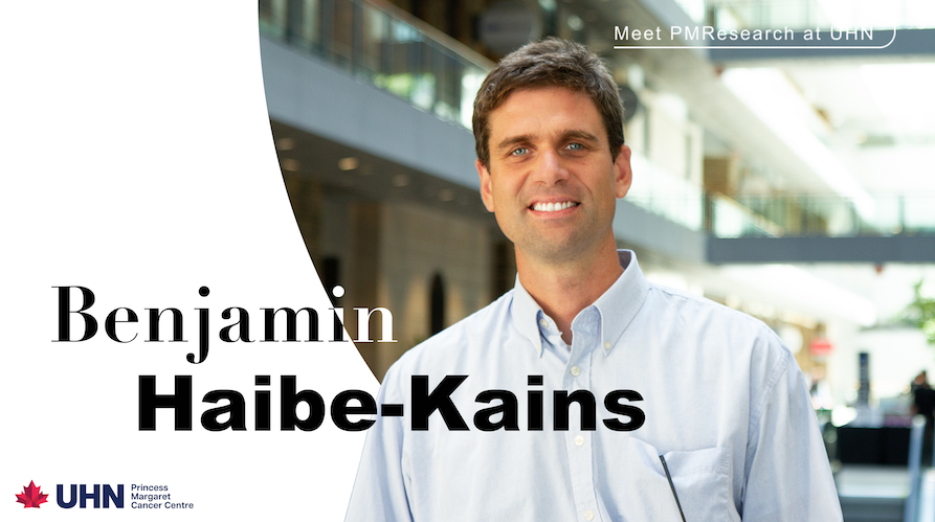
Dr. Benjamin Haibe-Kains is UHN’s Executive AI Scientific Director and Co-Director, UHN AI Hub, Senior Scientist and Allan Slaight Scientist at UHN’s Princess Margaret Cancer Centre, and Scientific Director of the Cancer Digital Intelligence Program at Princess Margaret Cancer Centre.
Dr. Benjamin Haibe-Kains was completing his PhD when a major cancer research scandal shook the scientific community.
A highly publicized study claiming to predict patients’ responses to chemotherapy was later found to be based on manipulated data, leading to retracted papers, suspended clinical trials and years of wasted research effort.
Watching the case unfold and seeing the consequences profoundly influenced Benjamin’s approach to science. “I suddenly realized that if I'm not being completely open and transparent about what I do and if I make mistakes, it could take years for people to correct them and do what’s right for patients,” he recalls. “And for me, that was not an acceptable risk. So, I decided to invest my effort in the principles of open science.”
Today, with many leadership roles at UHN and its Princess Margaret Cancer Centre (PM), Benjamin is helping shape how artificial intelligence is developed and deployed in health care research, advocating for approaches that are not only innovative, but also trustworthy, transparent, and beneficial to patients.
Guardrails for developing AI models
“Every year, hundreds of studies are published describing predictive models for cancer care, but very few ever make the leap into clinical practice,” says Benjamin. “Pursuing a wrong model not only wastes time and resources, but could also negatively impact patient care.”
This troubling trend prompted Benjamin and a group of international collaborators to set up an industry standard—the Seven Hallmarks of Predictive Oncology—designed to evaluate the quality, reliability, and clinical potential of AI models before they reach the bedside.
“We use these hallmarks to identify models with the greatest potential for clinical translation and to minimize risks before they enter hospitals,” Benjamin explains.
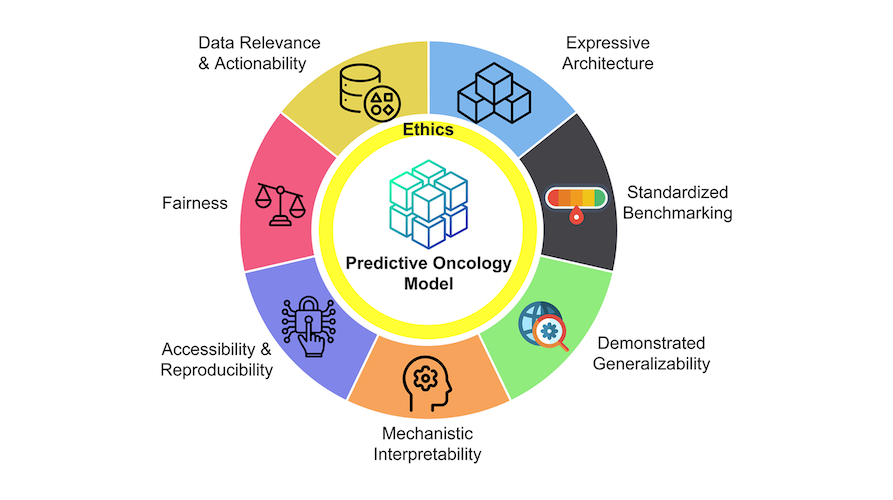
The seven hallmarks of predictive oncology (Graphic credit to Singhal et al., Cancer Discovery AACR Journal)
Together, the hallmarks assess whether a model is built on data that are relevant to patient care and available in real-world settings; whether the design is complex enough to capture the biology of cancer without overfitting the data; whether it has been rigorously benchmarked against existing approaches; whether the study can make accurate predictions for new patients beyond the population on which it was trained; whether clinicians can understand the factors driving its predictions; whether other researchers can reproduce its results; and whether it performs equitably across diverse patient populations and not just groups represented in the training data.
In addition to scientific rigour, each hallmark carries important ethical considerations. “If you push a model that is not sufficiently accurate, you may waste precious health care resources and reduce the likelihood of patient benefit,” he explains. “Ethical considerations must be embedded in every step of AI development.”
Using computational science for cancer discoveries
Cancer research was not part of Benjamin’s original career plan. He studied computer science at the Université Libre de Bruxelles and was initially interested in robotics. His path changed when a supervisor introduced him to the emerging field of bioinformatics.
“That’s when I started to work with clinicians,” Benjamin recalls. “I got hooked by the fact that I could be working to help the patients at the end of the day.”
Working alongside cancer biologists, bioengineers, and clinicians during his PhD, he learned the language of cancer research while applying computational approaches to uncover previously unknown subtypes of breast cancer.
Benjamin later pursued postdoctoral training to develop more sophisticated computational methods, moving beyond simply applying existing ones. At the Harvard School of Public Health and Dana-Farber Cancer Institute, he studied how genes interact in complex networks, deepening his expertise in machine learning and predictive oncology.
After joining Princess Margaret in 2013, Benjamin led a landmark study with collaborators at the Université de Montréal to better understand why some patients respond to immunotherapy while others do not. The team assembled data from 26 clinical trials spanning 12 cancer types and three classes of immunotherapies, bringing together molecular profiles and treatment outcomes from more than 3,600 patients.
“We analyzed each gene individually to determine whether it could predict response to immunotherapy,” Benjamin explains. “This led us to identify a 100-gene signature that was more predictive than previously published approaches across multiple cancer types.”
The team identified two promising new immunotherapy targets by examining the functions of the genes in the signature. The targets are currently being investigated by study co-lead Dr. John Stagg, Director of the McGill Goodman Cancer Centre.
“I have always enjoyed collaborating with scientists around the world, but the highly collaborative culture of Canadian research makes these partnerships especially rewarding and productive,” Benjamin says.
Bringing AI to clinical settings
Benjamin co-leads PM’s Cancer Digital Intelligence (CDI) program with radiation oncologist Dr. Alejandro Berlin to smoothly translate AI technologies into clinical application.
“What we are trying to do is to build a bridge between research and clinical application and foster more innovations within the institute.”
One example is a predictive model developed by Dr. Robert Grant’s team to identify cancer patients who are likely to return to the emergency department for treatment-related complications. CDI helped refine the model and support its deployment in the clinic, where it is currently being evaluated in a “shadow mode” environment alongside routine clinical care.
Another flagship CDI initiative is PMATCH, an AI-enabled platform designed to connect patients with relevant clinical trials more efficiently. The system automatically extracts key information from patient records, evaluates it against trial eligibility criteria, and alerts clinicians to potential matches. Now operating as a pilot at Princess Margaret, PMATCH processes data from more than 200 patients each week, with plans to expand the platform beyond Ontario.
“We want to see whether this technology can be used across multiple hospitals, to help more patients access clinical trials regardless of where they receive care,” Benjamin says.
Humans have a lot to give in this AI-driven world
When it comes to concerns about the rapid pace at which artificial intelligence is transforming society, Benjamin's advice is to embrace the technology while understanding its limitations.
“We need to learn how to use these tools effectively without giving up on our own creativity or judgment,” he says.
Benjamin believes AI excels at finding unexpected connections across different fields because of its broad knowledge base. What it struggles to replicate, he argues, is the kind of disruptive creativity from people who challenge conventional thinking and pursue entirely new directions. He cites examples like Albert Einstein and Marie Curie, iconoclasts whose transformative discoveries fundamentally changed how people understood the world.
“There will be an interplay between the creativity of humans trying to think out-of-the-box, and the creativity of AI to connect the dots in various fields.”
Specifically, biomedical research is entering a new era with the rise of AI co-scientists and automated laboratories. “We are at the stage to reimagine the scientific process where AI and human capabilities complement and strengthen one another,” says Benjamin. “Researchers who adapt and harness the potential of these technologies will be well positioned to shape what comes next and drive future innovation.”
Trust will play a critical role in the health care system. “AI may work 90 per cent of the time, but for the remaining 10 per cent, if humans are not in the loop and people don't trust the system anymore, there is no way we can fix the problem,” he says.
For that reason, he underscores the effort to assess the quality, reliability, and robustness of AI-related technologies before they can be used in a safe and responsible way in the clinic.
“Human-in-the-loop will remain essential for a long time,” he says. “Many complex health care decisions cannot be fully driven by AI. Clinicians, administrators, nurses and other health care professionals will continue to play a crucial role in the responsible use and evaluation of these new technologies.”
Meet PMResearch is a story series that features Princess Margaret researchers. It showcases the research of world-class scientists, as well as their passions and interests in career and life—from hobbies and avocations to career trajectories and life philosophies. The researchers that we select are relevant to advocacy/awareness initiatives or have recently received awards or published papers. We are also showcasing the diversity of our staff in keeping with UHN themes and priorities.