Finding the Right Balance
Repeated reactive balance training was associated with better balance control after stroke.
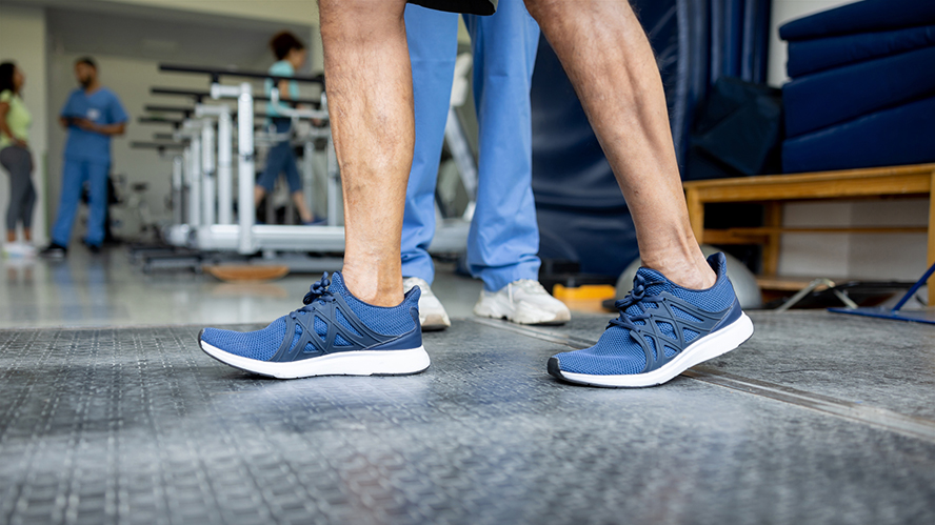
Stroke can affect balance responses needed for safe movements, increasing fall risk and affecting quality of life. Understanding how rehabilitation can help restore these critical skills may help improve independence and mobility after stroke.
For people recovering from a stroke, regaining the ability to walk independently is essential for returning to daily life. But safe mobility depends on being able to quickly recover from a stumble or sudden loss of balance—an ability that is often impaired after stroke. New research from UHN’s KITE Research Institute suggests that increased exposure to reactive balance training improves balance control after stroke.
Reactive balance training is a rehabilitation approach that intentionally exposes participants to controlled balance disturbances to help them practice regaining their balance in a safe environment. In previous studies, this training approach has shown promise in improving balance control after stroke; however, clinicians remain uncertain about how much training is needed to achieve meaningful improvements and which training characteristics matter most.
To explore this, the research team studied 30 people recovering from stroke who completed up to 12 one-hour training sessions over six weeks. During the sessions, participants practised recovering their balance from controlled balance disturbances triggered by activities such as kicking a soccer ball, walking on the spot, or responding to controlled pushes. Researchers tracked the number of balance disturbances experienced, task difficulty, success rate, and participants’ perceived level of challenge.
The findings showed that participants who experienced a greater number of balance disturbances showed larger improvements in reactive balance control. In contrast, task difficulty, success rate, and the perceived challenge level were not associated with better outcomes. The results suggest that repeated exposure to balance-recovery practice may play an important role in improving reactive balance control after stroke.
By emphasizing training volume and consistent exposure to balance challenges, clinicians may be able to better tailor rehabilitation programs and improve recovery outcomes for people living with the long-term effects of stroke. Further studies should explore how different task types interact with different individuals.
Júlia O. Faria, first author of the study, was a visiting PhD student from the University of São Paulo, Brazil.
Dr. Avril Mansfield, senior author of the study, is a Senior Scientist at UHN’s KITE Research Institute. At the University of Toronto, she is an Associate Professor in the Department of Physical Therapy and a Faculty Member at the Rehabilitation Sciences Institute.
This work was supported by UHN Foundation, the Canadian Institutes of Health Research, Canada Foundation for Innovation, the Ontario Government, and CAPES (Coordination for the Improvement of Higher Education Personnel).
Faria JO, Danells CJ, Inness EL, Mansfield A. Optimal Reactive Balance Training Characteristics Poststroke: Secondary Analysis of a Clinical Trial. Physiother Res Int. 2026 Jul. doi: 10.1002/pri.70231.