Hearing, Balance, and Thinking
Cognitive training improves balance and multitasking with varied benefits to hearing ability.
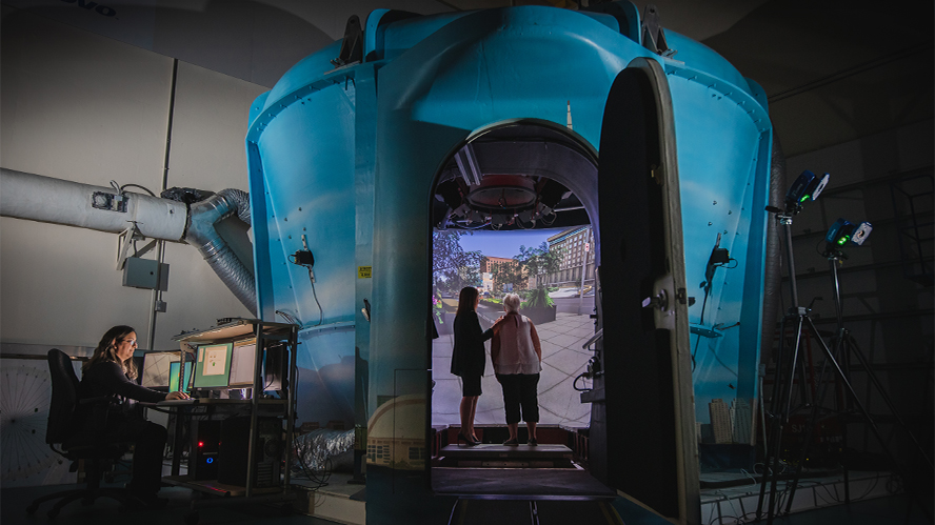
KITE Research Institute’s StreetLab is an immersive virtual reality facility that allows scientists to study complex interactions between sensory and cognitive processes. Study participants navigated a virtual street-crossing environment while simultaneously completing listening, memory, and standing balance tasks. (Image courtesy of KITE Studios)
Tasks that require staying balanced while listening and thinking—like crossing a busy street—can become increasingly difficult with age. Hearing loss is also common in older adults and has been linked to cognitive decline and a higher risk of falls, making everyday multitasking more challenging. A new study from UHN’s KITE Research Institute (KITE) found that cognitive training may support improved balance and cognition in older adults, but its benefits may be limited in individuals with more severe hearing loss.
To examine whether structured cognitive training could support improved balance in older adults with hearing loss, participants were randomly assigned to complete a 12-week cognitive training program or to a control group without training. Participants were middle-aged adults with normal hearing, older adults with normal hearing, and older adults with hearing loss. The at-home training program included short, computer-based sessions completed three times per week. The exercises involved remembering and identifying sequences of numbers, responding to visual cues (like images), and switching between tasks—activities designed to strengthen memory, attention, and mental flexibility.
Using KITE’s StreetLab, an immersive virtual reality simulator, to depict a large, urban street-crossing, researchers measured participants’ cognitive performance and balance before and after training. Participants completed a listening and memory task as well as a standing balance task, both separately and at the same time to simulate real-life multitasking.
The findings showed that participants who completed cognitive training improved their performance on listening and memory tasks and were better at managing multitasking demands, regardless of age and hearing ability. Participants with the poorest hearing and weaker initial cognition showed the greatest improvement in these tasks.
However, the effect on balance differed depending on hearing ability. Older adults with better hearing showed measurable improvements in stability after training, while those with more severe hearing loss did not show improvements.
These results reflect the complex links between hearing, cognition, and mobility. While cognitive training shows promise as a non-invasive way to support healthy aging, the findings suggest that early intervention—before hearing loss becomes severe—may be important for improving balance and reducing fall risk. As populations age, combining hearing care and cognitive training could offer a more comprehensive approach to maintaining independence and safety in everyday life.
Dr. Niroshica Mohanathas, first author of the study, is a former PhD student in the lab of Dr. Jennifer Campos.
Dr. Jennifer Campos, senior author of the study, is a Senior Scientist and Associate Director – Academic at UHN’s KITE Research Institute. At the University of Toronto, Dr. Campos is a Professor in the Department of Psychology and the Rehabilitation Sciences Institute. Dr. Campos is also a Tier 2 Canada Research Chair in Multisensory Integration and Aging.
This work was supported by UHN Foundation and the Canadian Institutes of Health Research.
Mohanathas N, Montanari L, Downey R, Li KZH, Pichora-Fuller MK, Bherer L, Lussier M, Phillips N, Wittich W, St-Onge N, Gagne JP, Campos JL. Effects of executive function training on balance and auditory-cognitive dual-task performance in adults with and without hearing loss. PLoS One. 2026 Apr 29;21(4):e0331276. doi: 10.1371/journal.pone.0331276.