Meet Dr. Jennifer Jones @PMResearch
From surviving to thriving: How research is reshaping life after cancer
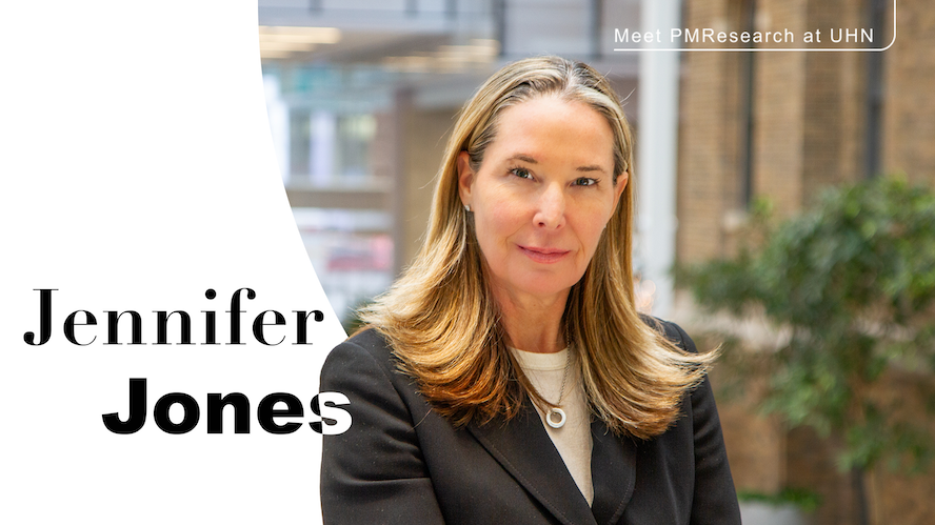
Dr. Jennifer Jones is a Senior Scientist, Director of the Cancer Rehabilitation and Survivorship Program, and the Butterfield/Drew Chair in Cancer Survivorship Research at UHN’s Princess Margaret Cancer Centre.
More people are surviving cancer today than ever before, due to recent advancements in early detection and treatments.
However, survival is only part of the story. Cancer and its treatments often leave people with long-term effects such as fatigue, pain, weakness, memory problems, and emotional distress. These challenges can last months or years, making it hard to return to work, care for family, and enjoy everyday life.
“Cancer changes everything,” says Dr. Jennifer Jones, Senior Scientist and Director of the Cancer Rehabilitation and Survivorship Program at UHN’s Princess Margaret Cancer Centre (PM). “For many patients, the challenge isn’t just getting through treatment; it’s what comes after.”
A new model of care: Transforming life after cancer
Jennifer leads the Cancer Rehabilitation and Survivorship (CRS) Program at PM, which is one of the largest comprehensive programs of its kind worldwide.
Patients with cancer-related impairments and disability are referred to CRS to receive a full assessment, a personalized plan to address their needs, and sometimes 1:1 follow-up consults.
Patients who have several impairments and deconditioning are typically enrolled in the CaRE program, which supports patients with eight weeks of tailored progressive exercise training and self-management classes addressing common side effects such as fatigue, cognitive impairments, and dealing with difficult emotions.
The CaRE program can be delivered in person by a multidisciplinary CRS team in small groups at the ELLICSR Centre for Health, Wellness and Cancer Survivorship, which was funded by the Canadian Foundation for Innovation. The CaRE@ELLICSR program also places a focus on nutrition, providing hands-on cooking classes with a wellness chef and dietitian. A prospective study of CaRE@ELLICSR showed that it improved patients’ physical activity, upper body muscular strength, and cancer-related symptoms.
“We see people regain strength, confidence, and control over their lives,” she says. “That’s what drives this work.”

CaRE@ELLICSR provides multi-dimensional rehabilitation care in group settings. Patients receive tailored exercise prescriptions, nutrition, and self-management classes to address their needs.
Research in a dynamic real-life situation
What sets the CRS program apart is how tightly care and research are connected.
Rather than treating research and clinical care as separate, Jennifer and her team have built an integrated model where each informs the other. Jennifer learned the model from her mentors, Dr. Gary Rodin, who founded the Department of Supportive Care at Princess Margaret, and Dr. Pamela Catton, former Director of Oncology Education and Cancer Survivorship at UHN.
When Dr. Catton passed away, Jennifer assumed the role of Director of the Cancer Rehabilitation and Survivorship Program. She carried on her legacy and their collective research that paved the way for the current program.
“What we study comes directly from what we see in the clinic,” she explains. “We identify the gaps, test solutions, and then bring those solutions right back into care.”
This approach has led to the rapid development and testing of new models like CaRE@Home, a virtual program designed to improve access. Early studies showed it is feasible, safe, and helps reduce disability. It is now being evaluated in a multi-centre Phase III trial funded through the Canadian Institutes of Health Research (CIHR) and the Canadian Cancer Society.
Other models of the CaRE program have been developed based on different patient needs: CaRE-Advanced Cancer, which was developed for people living with metastatic disease, helps patients maintain function, manage ongoing treatment effects, and sustain life roles. And CaRE-AYA was launched to address the specific needs of adolescents and young adults under 40.
Tailoring care for those who need it most
The same model is driving innovation for patients with more complex needs.
In 2019, Dr. Jonas Mattsson, Director of the Hans Messner Allogeneic Transplant Program at PM, contacted Jennifer to see how they could help patients undergoing allogeneic blood and marrow transplantation (allo-BMT) to be more active, so that they can better withstand and recover from transplantation.
Together, the two teams developed CaRE-4-AlloBMT, which is a longitudinal rehab program delivered before transplant, during hospitalization, and then 6 months after transplant.
“AlloBMT patients face many physical challenges from previous cancer treatments and the transplant itself. Incorporating multidimensional rehabilitation from pre- to post-transplantation is the ideal clinical approach. This can provide both a preventive ‘buffering’ and a restorative supportive measure,” says Jennifer.
In a Phase II trial, CaRE-4-AlloBMT was found to be feasible, acceptable, and safe, with promising results related to improving physical function and disability. To build on this, the team is now conducting a larger Phase III trial funded through CIHR.
Jennifer is excited and optimistic about this study: “This is a proactive approach that can bring promising benefits to preserve and optimize physical function, address alloBMT-related morbidities, minimize dysfunction, and enhance quality of life.”
Changing the future of cancer recovery
For Jennifer, the ultimate goal extends beyond a single program.
“We have a responsibility to build the evidence around cancer rehabilitation,” she says. “If we can show these programs work, we can make the case for broader access so patients across Canada can receive the care they need.”
Through an integrated model of clinical care and research, her team is not only helping patients recover, but they are redefining what recovery after cancer can look like.
Reflecting on the important things in life
Through her work with patients, Dr. Jennifer Jones has gained a unique perspective on what truly matters in life.
She has seen how a cancer diagnosis reshapes priorities, shifting focus away from work, status, and material things, and toward family, relationships, and meaningful experiences.
“People often come out of cancer with a very different lens,” she says. “They think more about how they want to spend their time and who they want to spend it with.”
That perspective has shaped how she approaches her own life.
“I work hard, but when I leave work, I’m fully present with my family,” she says. “That balance is incredibly important to me.”
She and her family also try to live the same healthy, active lifestyle she encourages in her patients, something she sees not as an obligation, but as an investment in long-term well-being.
“Don’t wait for a health crisis to start making changes,” she says. “Small, consistent steps, staying active, prioritizing your mental health, and making time for the people in your life, can make a huge difference.”
It is a message that reflects both her research and her lived experience:
“More people are surviving cancer. The goal now is to live well, and that’s something we should all be thinking about.”
Meet PMResearch is a story series that features Princess Margaret researchers. It showcases the research of world-class scientists, as well as their passions and interests in career and life—from hobbies and avocations to career trajectories and life philosophies. The researchers that we select are relevant to advocacy/awareness initiatives or have recently received awards or published papers. We are also showcasing the diversity of our staff in keeping with UHN themes and priorities.