The Art of Transplant Experience
Exploring lived experience through art reveals deeper insights into organ transplantation.
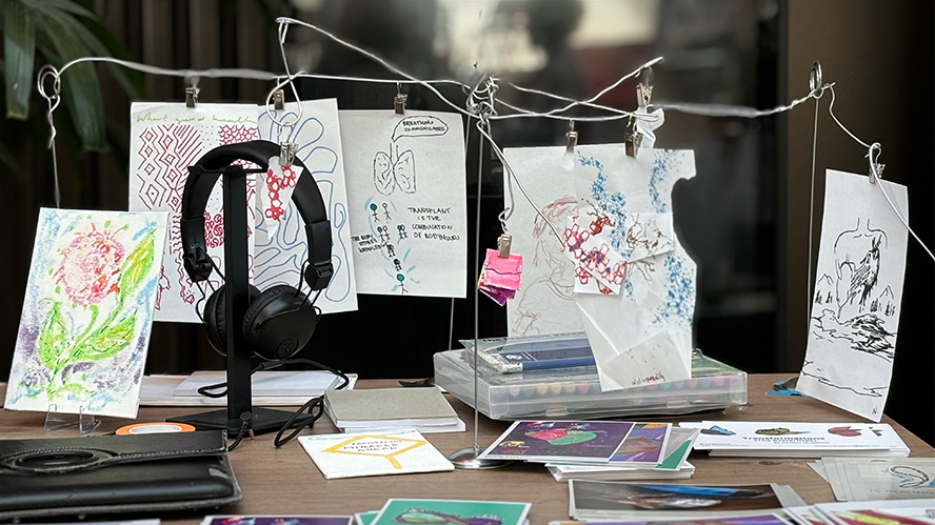
The artwork created by participants illustrates how arts-based approaches can capture the emotional and lived experiences of organ transplantation. (Image courtesy of Dr. Suze Berkhout)
Organ transplantation is often described as a life-saving intervention focused on positive clinical outcomes and recovery. At the same time, lived experiences are complex and include emotional challenges and mixed feelings about treatment. A research team from The Institute for Education Research at UHN, Carleton University, and York University explored public perspectives on organ transplantation using an arts-based approach to capture insights that may be missed by traditional research methods and support more patient-centred care.
To explore the social and emotional aspects of transplantation, researchers examined the use of art to understand people’s experiences and reflections on life after transplantation. To do this, the team hosted a series of public events, including art exhibitions, talks, conference sessions, and film screenings featuring stories, films, and artwork created by transplant recipients. Attendees were invited to reflect on the transplant-related events by creating their own drawings and designs using provided art supplies—a form of visual field notes.
Field notes are commonly used by researchers to document observations and better understand people’s experiences, practices, and cultures. In this study, the research team invited members of the public to contribute visual field notes, exploring a collective and accessible way of understanding the complexities of transplantation.
The research team analyzed the visual field notes, identifying four recurring themes. First, many of the pieces expressed difficult emotions, such as isolation, fear, and distress, often through the use of darker colours. Second, participants also used different materials and textures to represent physical and emotional experiences, such as loss or change. For example, a torn page was used to show organ removal or loss. Third, written and visual elements often represented internal conflicts about treatment and future outcomes. Lastly, many pieces challenged the idea that organ transplantation is a purely positive experience, highlighting how real-life experiences can be more complex.
The research team later assembled the pieces into a temporary, interactive sculpture and invited new participants to engage with it, encouraging discussion. This process revealed how perceptions of organ transplantation may change across different audiences.
Overall, the findings suggest that arts-based approaches may help deepen understanding of complex health experiences by capturing emotional and social aspects of organ transplantation that are often overlooked. By bringing these perspectives into research and care discussions, this work may help support more comprehensive, patient-centred care.
Dr. Kelly Fritsch, first author of the study, is an Associate Professor in the Department of Sociology and Anthropology at Carleton University. Dr. Fritsch is also a TIER 2 Canada Research Chair in Disability, Health, and Social Justice.
Dr. Suze Berkhout, senior author of the study, is an Education Investigator at The Institute for Education Research at UHN. Dr. Berkhout is also an Associate Professor in the Department of Psychiatry and Affiliate Faculty at the Institute for the History and Philosophy of Science and Technology at the University of Toronto.
This work was supported by UHN Foundation, the New Frontiers Research Fund, the Social Sciences and Humanities Research Council of Canada, and the Canadian Donation and Transplantation Research Program.
Fritsch K, Park M, Banerjee T, Berkhout S. Experimental Afters: On Meaning-Making with Collective Visual Fieldnotes. Leonardo. 2026 Apr 1. doi: 10.1162/LEON.a.2634.

Examples of the visual field notes created by participants. (Images courtesy of Dr. Suze Berkhout)