Advancing Care with Digital Lungs
Scientists at UHN develop digital twins of human lungs using Ex Vivo Lung Perfusion data.
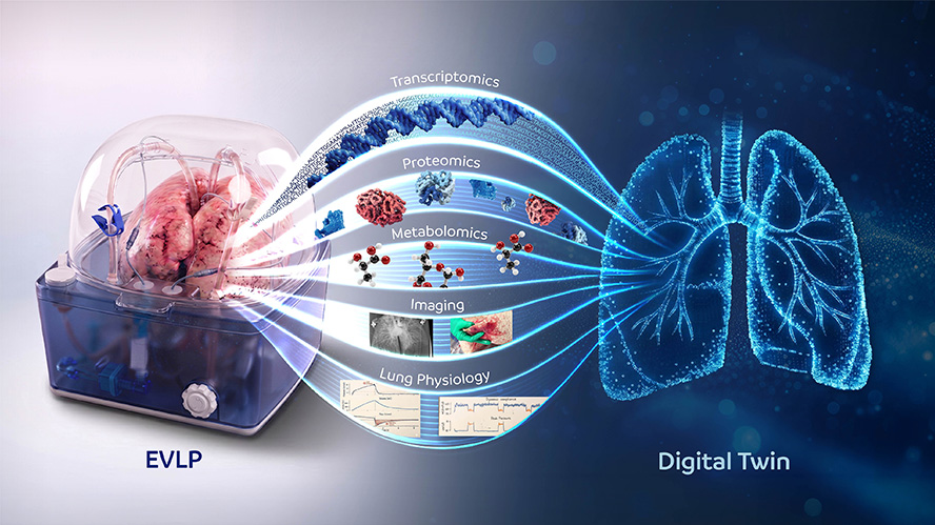
Scientists are building “digital twins” of organs through the use of real-world data and AI, creating virtual lungs that accurately reflect the complexity of how a real human lung works. (Image: Ariadna Villalbi)
The concept of a “digital twin”—a virtual representation of physical objects, such as an organ—is emerging as a way to accelerate medical research and improve patient care. Researchers from UHN’s Toronto Lung Transplant Program within the Ajmera Transplant Centre have developed a digital twin of a human lung using data from Ex Vivo Lung Perfusion (EVLP).
In the medical field, digital twins are comprehensive computer models that integrate molecular, physiological, functional, and clinical data to create virtual representations of biological systems. However, due to the lack of large datasets that combine these different types of data, creating a digital twin for health research has been difficult to achieve.
EVLP is a biomedical technique in which a donated lung is preserved at normal body temperature, enabling the lung to breathe on its own outside of the body. Invented at UHN, EVLP enables clinicians to safely assess donor lungs before transplant. The lung function data generated during EVLP—spanning imaging, physiological monitoring, and molecular assays—serves as a foundation for the development of a digital twin for the human lung, or a “digital lung”.
The research team, led by Drs. Andrew Sage, Assistant Scientist, and Shaf Keshavjee, Chief of Innovation, Senior Scientist, and Donald K. Jackson Chair in Lung Transplant Research at UHN, analyzed the largest known EVLP dataset and developed a method to generate a digital lung. Their model accurately simulated over 75 parameters of lung biology and health, including physiology, biochemical and gene-expression markers.
To determine how effective the digital lung model could be in assessing therapeutic treatment results, the team compared real-world results from EVLP lungs treated with alteplase, a drug that dissolves blood clots, to predictions from the digital twin. Results showed that the digital lungs were better at assessing therapy in human lungs.
These findings show that virtual lungs can accurately simulate lung function and predict treatment outcomes. Digital twins could become a powerful tool for evaluating therapies, improving drug development, and ultimately improving patient care.
Xuanzi Zhou is a Doctoral Candidate at the University of Toronto and UHN and the first author of the study.
Dr. Andrew Sage, an Assistant Scientist at UHN and Assistant Professor in the Department of Surgery at the University of Toronto, is the co-senior author of the study.
Dr. Shaf Keshavjee is a Senior Scientist and Chief of Innovation at UHN. He is also a Professor of Thoracic Surgery and Biomedical Engineering and Vice Chair for Innovation in the Department of Surgery at the University of Toronto. He is the co-senior author of the study.
This work was supported by the Canadian Institutes of Health Research (CIHR), the J.P. Bickell Foundation, and UHN Foundation.
Dr. Shaf Keshavjee serves as Chief Medical Officer of Traferox Technologies and receives personal fees from Lung Bioengineering, outside the submitted work. Xuanzi Zhou, Andrew, Sage, Shaf Keshavjee, and other authors declare ongoing patent applications with the University Health Network related to ex vivo digital twin machine learning models used in this study.
Zhou X, Wang B, Wei Y, Hacker S, Kim S, Borrillo T, McCaig A, Ahmed H, Ren Y, Hough O, Orsini L, Chao BT, McInnis M, Cypel M, Liu M, Yeung JC, Del Sorbo L, Keshavjee S, Sage AT. Digital twins of ex vivo human lungs enable accurate and personalized evaluation of therapeutic efficacy. Nat Biotechnol. 2026 May 4. doi:10.1038/s41587-026-03121-4.