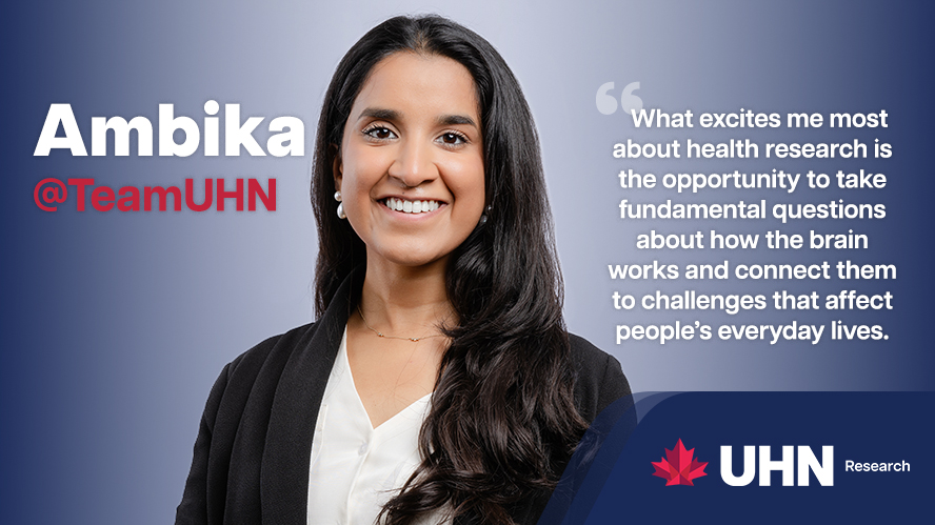
Ambika @TeamUHN
Dr. Ambika Bansal is a Postdoctoral Researcher at UHN’s KITE Research Institute.
Tell us about your role at UHN.
I am a Postdoctoral Researcher at UHN’s KITE Research Institute (KITE) and a recruit from the Canada Leads program. I am in Dr. Behrang Keshavarz’s lab where I specialize in neuroscience with expertise in motion sickness, multisensory integration, and driving safety.
My day-to-day work involves designing and conducting behavioural research studies in collaboration with other researchers and clinicians, analyzing and interpreting data, and translating our findings into knowledge that can ultimately help improve human health.
How long have you been at UHN and what led you to this role?
I have been at UHN for around nine months. I have my master’s and PhD in Neuroscience from the Centre for Vision Research at York University, where I studied how the brain uses sensory information to perceive our movement and navigate through the world.
My past research ranged from understanding how we learn and adapt our movements to exploring how our perception of self-motion changes in different environments, including how astronauts perceive their movement aboard the International Space Station. This work sparked my interest in how conflicts in sensory information can affect how we feel and function, particularly through experiences like motion sickness. My role at UHN was a natural next step, giving me the opportunity to build on this research while exploring its real-world applications.
What are you passionate about in your role at UHN? What does health research mean to you?
I am passionate about advancing sensory-motor research that can be applied to areas such as aging and rehabilitation technology. What excites me most about health research is the opportunity to take fundamental questions about how the brain works and connect them to challenges that affect people’s everyday lives. I am particularly passionate about understanding how our sensory systems shape perception and movement, and how emerging technologies can help us better understand, assess, and potentially rehabilitate these systems. To me, health research means combining curiosity with a clear purpose of generating knowledge that can ultimately improve people's health and quality of life.
How does your work help to advance UHN's vision of A Healthier World?
My work contributes to UHN’s vision of A Healthier World by aiming to understand the brain and the sensory processes that allow us to safely perceive, navigate, and interact with our surroundings. By studying these processes and exploring how technologies such as virtual reality and driving simulators can be used in research and rehabilitation, I hope to bridge the gap between our understanding of the brain and practical approaches that support healthy aging, rehabilitation, and mobility.
What makes UHN an ideal place to advance health research?
UHN, and in particular KITE, provides a unique environment where rehabilitation science, technology, and clinical expertise come together to address real-world health challenges. I am particularly excited to work within KITE’s Challenging Environment Assessment Laboratory (CEAL), where state-of-the-art facilities enable us to safely recreate complex, real-world conditions and study how people perceive, move, and respond to their environments.
For my research in multisensory integration, motion sickness, and driving safety, having access to these facilities alongside an interdisciplinary community of scientists, clinicians, engineers, and trainees creates opportunities to translate fundamental neuroscience into meaningful solutions for aging and rehabilitation.
Tell us an interesting fact people don’t know about you. Do you have any hobbies or interests outside of work?
One interesting fact people might not know about me is that I was on the varsity squash team during my undergraduate and master's programs. Outside of work, I love hiking, gardening, and exploring Toronto's incredible food and music scenes.
What do you see for the future of health research, and what gets you excited about it?
I see the future of health research becoming increasingly interdisciplinary, with new technologies enabling us to study human health in ways that were not previously possible. I am particularly excited by the potential of emerging technologies to create more precise ways of understanding, assessing, and supporting brain and sensory function.
How to Participate in You @TeamUHN
You @TeamUHN is a campaign to highlight the important scientific contributions that research lab staff, trainees and learners, administrative staff, core facilities staff, Research Solutions & Services staff, and volunteers make towards A Healthier World through discovery and innovation. If you’re interested in sharing your story, we invite you to complete this form here (Open to UHN staff, trainees and volunteers).