New Approaches to Balance Training
Testing a depth camera as a more accessible tool for balance rehabilitation.
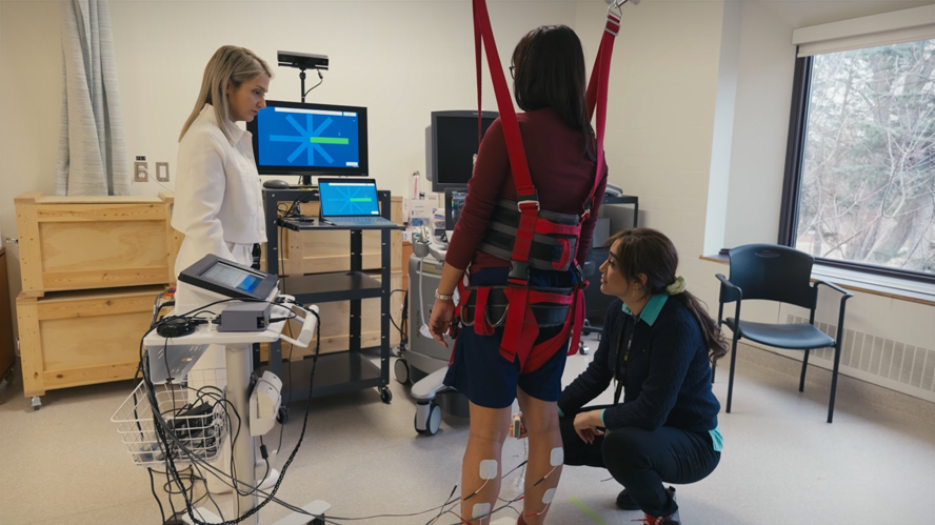
Balance rehabilitation aims to help people with neurological impairments restore and improve motor control. Visual feedback balance training and electrical stimulation (pictured above) use visual cues and muscle activation to support better balance control. (Image Credits: Qin Dai, Biomedical Engineering at the University of Toronto)
Restoring balance and motor function for people with neurological conditions and impairments, including spinal cord injury, is critical for maintaining quality of life. However, current rehabilitation therapies often have limited clinical accessibility because they rely on expensive and specialized equipment. New research from UHN’s KITE Research Institute found that a low-cost depth camera may offer a more accessible and practical approach for delivering balance rehabilitation.
Specialized therapies that combine visual feedback balance training (VFBT) and electrical stimulation can help improve standing balance. VFBT uses visual cues to help people adjust their body position and improve balance and stability. Combining VFBT with functional electrical stimulation (FES), which sends electrical pulses to activate muscles in the lower legs, can enhance the effects of rehabilitation by helping the nervous system relearn movement patterns and improve motor control.
Currently, the VFBT-FES system relies on a force plate—a specialized device that measures how a person’s weight shifts while standing—to guide training exercises and signal when electrical stimulation should be delivered. However, force plates are costly and not widely available in rehabilitation settings, limiting access to these therapies.
To develop a more accessible alternative, the researchers evaluated how accurately a depth camera, which tracks movement in 3D, could measure a person’s body position to guide balance training and electrical stimulation. This study builds on the team’s previous work and assesses whether a depth camera can replace the force plate within the VFBT-FES system.
Ten participants without neurological impairments completed a series of VFBT exercises while researchers collected body position measurements from a depth camera and compared them with separate measurements from a force plate and a motion-capture system—an established method for tracking movement.
The research team found that the depth camera’s measurements closely matched those of the force plate and the motion-capture system. The camera-based system also signalled muscle stimulation in a similar manner to the force plate-based system.
The findings show that a depth camera can provide accurate feedback for both movement tracking and stimulation control. By replacing costly force plates with portable, affordable technology, the camera-based approach could help expand access to balance rehabilitation and support broader use of FES-based balance training in clinical and community settings.
Derrick Lim, first author of the study, is a PhD candidate in the lab of Dr. Kei Masani at UHN’s KITE Research Institute.
Dr. Kei Masani senior author of the study, is a Senior Scientist at UHN’s KITE Research Institute and an Associate Professor at the Institute of Biomedical Engineering at the University of Toronto.
This work was supported by the Canadian Institutes of Health Research, the Natural Sciences and Engineering Research Council of Canada, and UHN Foundation.
Lim D, Pei W, Lee JW, Musselman KE, Masani K. Feasibility of a depth camera-based center of mass feedback system for closed-loop functional electrical stimulation therapy and visual feedback balance training. Biomed Phys Eng Express. 2026 Jul 23. doi: 10.1088/2057-1976/ae89bc.