Revealing Cancer Risk in Bone Marrow
Study reveals links between stem cell mutations and bone marrow changes before cancer develops.
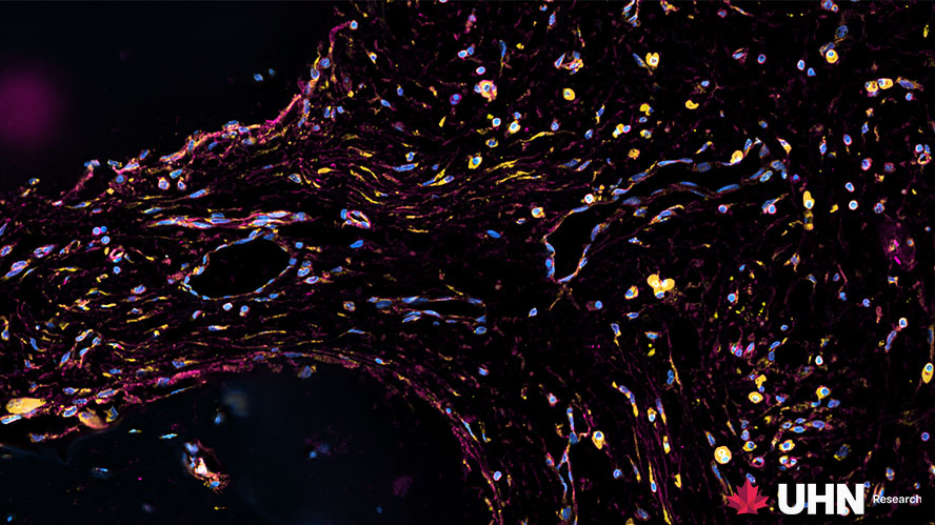
The bone marrow is home to blood-forming stem cells that produce all of the body's blood and immune cells. Image depicts a representative snapshot of bone marrow tissue from the research team’s spatial analysis and demonstrates evidence of early stem cell environment remodelling. Cell nuclei are visualized in blue, cell membranes in pink, and the cytoplasm in yellow. (Image: Tikhonova lab)
Clonal hematopoiesis of indeterminate potential (CHIP) is an age-related condition in which blood stem cells acquire selective mutations that may lead to increased risks of mortality and illnesses such as blood cancer. A new study from UHN’s Princess Margaret Cancer Centre (PM) published in Nature Immunology shows how the bone marrow environment changes in people with CHIP, before cancer develops.
The bone marrow, the soft tissue found within bones, is the main site of blood cell production (hematopoiesis). Blood stem cells (hematopoietic stem cells, HSCs) are self-renewing cells that continue to produce immune cells for life. This process is regulated by the specific supportive environment (microenvironment) within the bone marrow, called the bone marrow niche.
The bone marrow niche is a dynamic environment that undergoes continuous remodeling in response to physiological stress and disease. As people age, the niche becomes more inflammatory and less supportive of normal blood cell production. In this environment, some HSCs can acquire genetic mutations that give them a growth advantage. When these mutated clones reach a frequency of 2% in the blood, this is diagnosed as CHIP.
Structural changes to the niche are a hallmark of several blood cancers and research indicates that these changes may begin before cancer develops. Emerging research suggests that CHIP-related mutations can make the immune system more inflammatory, which can increase the risk of leukemia and other cancers. However, how the bone marrow niche changes specifically in those with CHIP is largely unknown.
To shed some light on this, the research team led by Dr. Anastasia Tikhonova, Senior Scientist at PM, performed a large-scale analysis of gene expression at the single-cell level in human bone marrow tissue.
The team found that CHIP is associated with inflammation and remodelling of the bone marrow microenvironment. There was an increase in fibroblasts—a cell type that produces collagen and is important for tissue remodelling—in CHIP samples compared to normal samples and these fibroblasts adopted gene expression patterns associated with cancer. In addition, other bone marrow cells helped increase collagen production as well as the activity of pathways involved in remodelling bone marrow tissue.
Spatial analysis found evidence of fibroblast-rich and pro-inflammatory regions in the bone marrow niche, called fibro-inflammatory hubs. These localized hubs contained activated fibroblasts and immune cells, and enrichment of inflammatory signalling, generating conditions that favour the expansion of mutant stem cells and cancer development.
Overall, these findings shed light on how CHIP may remodel the bone marrow microenvironment and how this remodeling could be an early event in disease progression. Further evidence may help to determine whether the altered bone marrow niche could serve as a marker of cancer risk as well as a therapeutic target.
Dr. Alicia Aguilar-Navarro is a Postdoctoral Researcher in Dr. Tikhonova’s lab at UHN and co-first author of the study.
Gibran Edun is a Research Associate in Dr. Tikhonova’s lab at UHN and the co-first author of this study.
Dr. Anastasia Tikhonova is a Senior Scientist at UHN’s Princess Margaret Cancer Centre and the senior author of the study. She is also an Assistant Professor in the Department of Medical Biophysics at the University of Toronto and an Investigator at the Ontario Institute for Cancer Research (OICR).
This work was supported by the Canadian Institutes for Health Research, the Canadian Cancer Society, Terry Fox Research Institute, Leukemia and Lymphoma Society Canada, the Natural Sciences and Engineering Research Council of Canada, the Ontario Institute for Cancer Research, Blood Cancer United, and The Princess Margaret Cancer Foundation.
Dr. Anastasia Tikhonova is a Tier II Canada Research Chair in Stem Cell Niche Biology.
Co-author Shruti Naik is a cofounder of Stara Biosciences.
Aguilar-Navarro AG, Edun G, Gower M, Kant J, Li X, Yang D, Nader M, Fernandez M, Jahangiri S, Tsao E, Joshi P, Kossinna P, Caloren LC, Davey JR, Zywiel MG, Suderman RP, Kapoor AI, Akens MK, Changoor A, Woo M, Stanley RF, Young KA, Tran C, Sotov V, Wang BX, Abelson S, Abdel-Wahab O, Naik S, Trowbridge JJ, Vanner R, Hope KJ, Tsui H, Gaiti F, Tikhonova AN. Prefibrotic bone marrow microenvironment is a hallmark of clonal hematopoiesis. Nat Immunol. 2026 Nov;27(11):2335-2350. doi: 10.1038/s41590-026-02668-3. Epub 2026 Sep 30.