Untangling Heart Failure Complexity
Protein analysis identifies heart failure subtypes that could guide future care.

Determining the molecular changes that underlie the varying causes and symptoms of heart failure could help predict treatment response and identify new drug targets.
Despite medical advances, heart failure (HF) remains a leading cause of death and burden on health care systems around the world. A new study from UHN’s Peter Munk Cardiac Centre and the University of Toronto has identified important molecular differences between patients with HF that may explain differing responses to treatment.
The underlying cause of HF can vary from person to person, and multiple factors may contribute to its development, including inherited heart conditions, previous heart attacks, inflammation of the heart muscle, and damage caused by certain cancer treatments. The multifaceted nature of its development has made understanding the molecular changes associated with HF a challenge.
Despite diverse causes, patients are often treated using similar approaches. As a result, current standards of treatment are not equally as effective for everyone. Understanding differences between patients could help explain why some people respond better to treatment than others and may help pave the way for more personalized treatments.
Proteins influence gene activity and affect signalling pathways that regulate heart function. Due to small sample sizes and difficulty in representing the different types of HF, previous attempts at analyzing the protein profiles of patients with HF have been challenging.
To address these limitations, the research team performed a large-scale analysis of the proteins in heart tissue samples from 149 patients with advanced HF caused by nine different underlying conditions.
The team found that although patients had different clinical symptoms and causes of HF, their heart samples shared many similar molecular changes at end-stage disease. However, further analysis revealed that the samples could be divided into two distinct subgroups based on the expression of proteins linked to fibrosis (scarring) and inflammation during the process of cardiac remodelling—changes to the heart’s size, shape, and function in response to cardiac disease.
The results of an analysis of protein phosphorylation—a type of protein modification that can indicate which signalling proteins are active—supported the subgroup division. This analysis also identified specific signalling molecules associated with a defined subgroup of patients that could be potential drug targets.
In addition, by comparing the pattern of proteins (protein signatures) associated with each subgroup to an independent dataset, researchers found that the subgroups also applied to earlier stages of HF. They found that these protein signatures could be detected in the blood, supporting their potential use as blood-based markers of HF. The protein signatures were also associated with different survival outcomes, providing evidence that they could be used to assess HF prognosis and other characteristics.
Overall, this research provides new insight into the biological differences that underlie HF and may help pave the way for more personalized treatment approaches. Future studies are needed to determine whether the newly identified protein signatures could be targeted to create new treatments and improve patient outcomes.
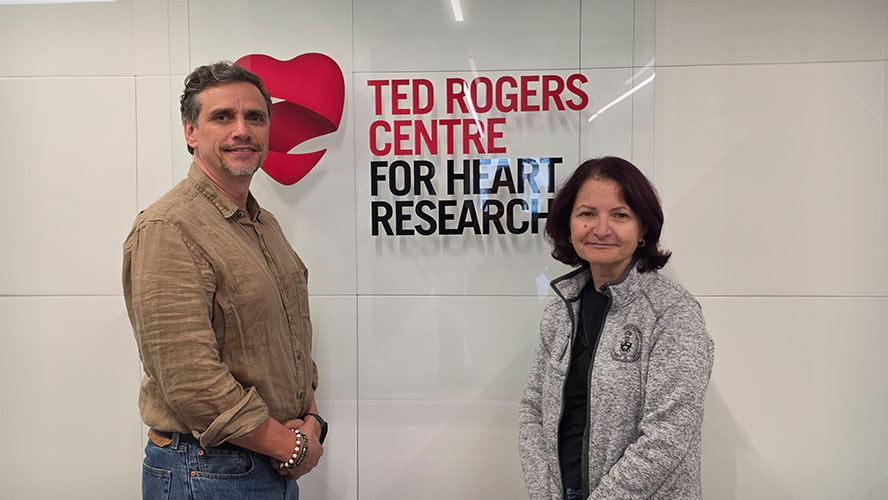
Dr. Gramolini (left) and Dr. Filio Billia (right); (photo: Ted Rogers Centre for Heart Research)
Dr. Omar Hamed, Postdoctoral Researcher at the University of Toronto, is the first author of this study.
Dr. Anthony Gramolini, Professor in the Department of Physiology at the University of Toronto, is the co-corresponding author of the study.
Dr. Filio Billia, Senior Scientist at UHN’s Peter Munk Cardiac Centre and Ajmera Transplant Centre, and Associate Professor in the Department of Medicine at the University of Toronto, is the co-corresponding author of the study.
This work was supported by the Ted Rogers Centre for Heart Research, the Canadian Institutes of Health Research, the Heart and Stroke Foundation of Canada, and UHN Foundation.
Dr. Anthony Gramolini is the Ted Rogers Chair in Cardiovascular Systems Biology.
Dr. Filio Billia is the Ted Rogers and Family Chair in Heart Function
Hamed O, Reitz CJ, Kuzmanov U, Gramolini S, Hu M, Halpern J, Billia F, Gramolini AO. Cardiac proteomic and phosphoproteomic profiling defines clinically relevant molecular subgroups in human heart failure. Nat Cardiovasc Res. 2026 Oct;5(10):1016-1033. doi: 10.1038/s44161-026-00880-w. Epub 2026 Sep 25.