Designing with Intention
Exploring how road intersection design shapes safety and mobility for people with disabilities.
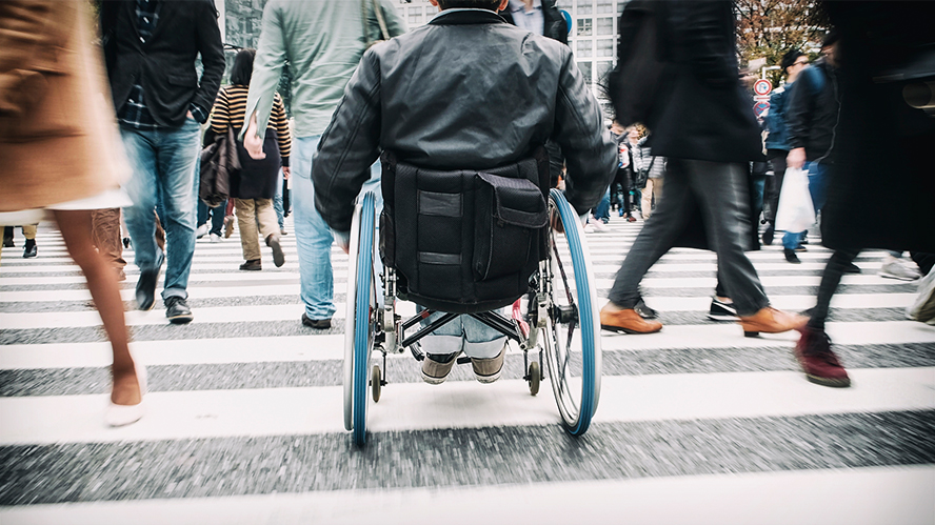
For people with disabilities, well-designed and well-maintained intersections can help make navigating busy urban environments safer and more accessible.
Navigating street intersections can be an everyday challenge for people with disabilities, affecting their safety, confidence, and ability to move independently through their communities. Researchers at UHN’s KITE Research Institute found that accessible streets require intentional design, ongoing maintenance, and engagement with people with disabilities in their design and evaluation.
Urban planning strategies such as the Complete Streets approach aim to make streets more accessible by considering the different and competing roles of all road users, including pedestrians, cyclists, transit users, drivers, and people of varying ages and abilities. Despite the growing use of this approach, the perspectives of people with disabilities have been underrepresented in evaluating these designs, limiting the understanding of how well they meet the needs of their intended users.
To address this gap, the research team explored the experiences of 24 people with mobility, visual, or hearing disabilities as they crossed two busy urban intersections in downtown Toronto that were designed using the Complete Streets approach. Participants completed four sets of crossings and shared which design elements helped or hindered their ability to cross safely and comfortably.
Participants identified several design features that influenced their experiences. Well-maintained accessibility features, such as pavement markings and pedestrian signals, helped support safe and confident navigation, whereas poor maintenance, such as uneven pavement, created additional barriers. Consistent design elements, including tactile warning surfaces at curb edges, also made intersections more predictable, easier to navigate, and minimized cognitive and physical effort for the individual.
While the presence of multiple forms of transportation, including cars, public transit, and bicycles, can sometimes provide directional cues for those with visual disabilities, participants also described difficulties and heightened anxiety associated with sharing space with multiple modes of transportation. Participants also raised concerns about navigating intersections during snowy, icy, or wet conditions.
Overall, the study highlights the importance of including people with disabilities in the design and evaluation of public infrastructure. The findings suggest that accessible streets require thoughtful design and ongoing maintenance to support safe, predictable, and independent mobility for everyone.
Mara Primucci, first author of the study, was a former Research Analyst in the lab of Dr. Alison Novak at UHN’s KITE Research Institute.
Dr. Alison Novak, senior author of the study, is a Senior Scientist at UHN’s KITE Research Institute. At the University of Toronto, Dr. Novak is a Faculty Member of the Rehabilitation Sciences Institute and an Associate Professor in the Department of Occupational Science & Occupational Therapy.
This work was supported by UHN Foundation and the Canadian Institutes of Health Research.
Primucci, M., Gardner, P., Maisel, J., Lau, S.-T., Campos, J., Li, Y., Levine, I., & Novak, A. (2026). The Impact of Design Elements on the Street Crossing Experience for Individuals with Disabilities at a Complete Street Intersection. Transportation Research Record: Journal of the Transportation Research Board. 2026 Aug 24. DOI: 10.1177/03611981261472777