Expanding the Reach of CAR T
New approach to specialized cancer immunotherapy may improve precision and broaden impact.
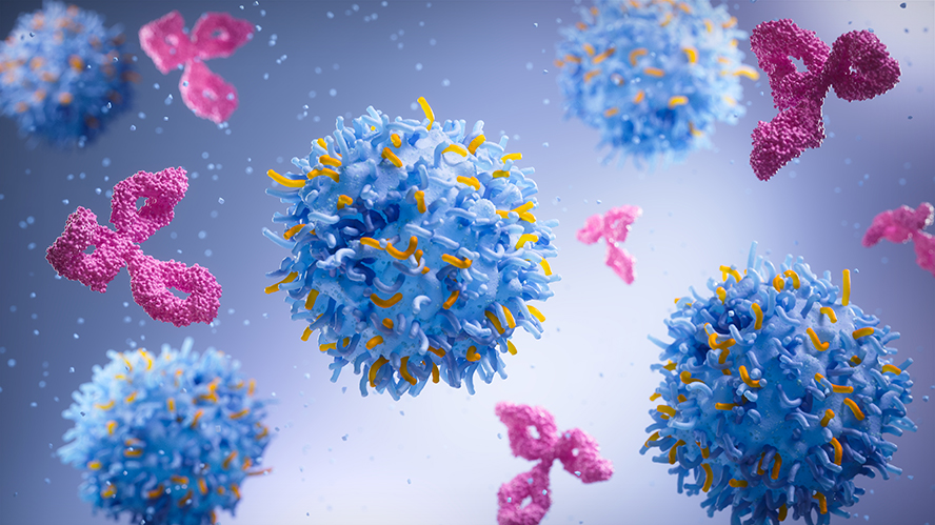
Cancer immunotherapies, like CAR T, train immune cells to recognize cancer-specific targets. One way they do this is by targeting small pieces of cancer proteins that are displayed on the cell surface by molecules called HLA. Researchers are trying to improve the specificity and effectiveness of this approach.
Chimeric antigen receptor T cell therapy (CAR T) has transformed the treatment of certain blood cancers. However, this approach has been difficult to apply to other cancers, such as solid tumours. Researchers at UHN’s Princess Margaret Cancer Centre (PM) have identified a new CAR T strategy that can target a protein found in many cancer cells, potentially broadening its application to more cancer types.
CAR T is a cancer immunotherapy that works by harnessing and reprogramming a patient’s own immune cells to recognize and attack cancer cells. A major challenge of these therapies is identifying suitable targets that are also unique to cancer cells.
CAR T therapies are designed to recognize and target specific proteins on the surface of cancer cells (surface antigens). This can be a limitation of the therapy as it is challenging to identify surface targets that are specific to cancer cells. In addition, these therapies often target protein fragments presented by human leukocyte antigen (HLA) Class I molecules on cell surfaces. However, HLA Class I molecules are found on most cells, making it difficult to distinguish cancer cells from healthy cells, increasing the risk that these therapies will also affect healthy tissue.
Researchers have begun exploring protein fragments presented by HLA Class II molecules—which are found on fewer healthy cells but can be present at higher levels on some cancer cells.
Wilms tumour 1 (WT1) is a protein found inside cells that has been associated with many cancers, including leukemia. Because conventional CAR T cells typically recognize proteins on cell surfaces, WT1 has been difficult to target using this approach. PM researchers have developed a new approach, designing CAR T cells that recognize WT1 protein fragments presented by HLA Class II molecules.
In laboratory studies, the engineered CAR T cells successfully identified and attacked leukemia cells that presented WT1 fragments through HLA Class II molecules. The therapy showed strong anti-cancer activity both in cell-based experiments and preclinical models, while selectively targeting cancer cells. The WT1-CAR T cells only recognized and attacked cancer cells when both WT1 and HLA Class II molecules were present together.
Most immune therapies that target proteins presented by HLA molecules are restricted to a specific HLA type, limiting the patients who may be eligible for treatment. However, this new WT1-CAR T was able to recognize the WT1 protein fragment when it was presented by 18 of the 20 HLA Class II molecules tested. This could make the approach applicable to a broader and more genetically diverse group of patients.
While further research and clinical testing are needed, this approach could expand CAR T cell therapy beyond its current applications, offering new treatment possibilities for people with myeloid leukemia and other cancers, such as ovarian cancers and mesothelioma, that have remained difficult to treat.
Evey Zheng, a Doctoral Candidate at UHN’s Princess Margaret Cancer Centre, is the co-first author of the study.
Dr. Chung-Hsi Wang, a Postdoctoral Research at UHN’s Princess Margaret Cancer Centre at the time of the study, is the co-first author of the study.
Dr. Naoto Hirano is a Senior Scientist at UHN’s Princess Margaret Cancer Centre and a Professor in Immunology at the University of Toronto. He is the corresponding author of the study.
This work was supported by the Canadian Institutes of Health Research, the Longo Family Cancer Foundation, the Ira Schneider Memorial Cancer Research Foundation, and The Princess Margaret Cancer Foundation.
Dr. Naoto Hirano is Tier 1 Canada Research Chair in Immunology to Immunotherapy.
Dr. Hirano reports a patent for Anti-WT1 Antigen-Binding Proteins and Uses Thereof pending.
Zheng EYF, Wang CH, Ochi T, Ohashi Y, Ihara F, Fukao S, Ito Y, Boukhaled GM, Wang BX, Han DH, Wei X, Yolmo P, Burt BD, Saso K, Matsunaga Y, Ly D, Kagoya Y, Butler MO, Minden MD, Hirano N. CAR T Cells Targeting an Intracellular Leukemia Antigen Promiscuously Presented by Diverse HLA-II Alleles. Blood Cancer Discov. 2026 Sep 3;7(5):813-828. doi: 10.1158/2643-3230.BCD-25-0230.