




Remote patient management (RPM) programs enable patient care to be accessible from anywhere. For heart failure—a serious condition in which the heart does not pump blood as well as it should—remote management can help track health data, detect early warning signs, and alert care teams when interventions are needed. In a new study, researchers at UHN found that well-designed remote management programs can make heart failure care more equitable and accessible.
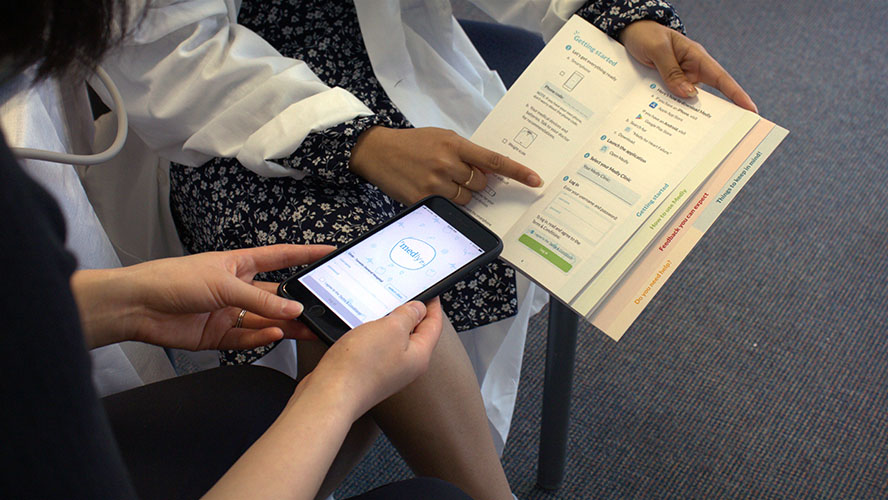
Medly is a digital therapeutic platform for heart failure management and care developed at UHN by Clinician Investigator Dr. Heather Ross and Senior Scientist Dr. Joseph Cafazzo. The platform was developed in concert with UHN's Peter Munk Cardiac Centre and Centre for Digital Therapeutics, as well as the Ted Rogers Centre for Heart Research. Medly is an RPM program that enables patients to record symptoms, heart rate, blood pressure, and daily weight on a mobile device—most often a smartphone—and receive personalized self-care messages generated by a clinically validated algorithm.
The program was designed to be used with any smartphone, regardless of the model or operating system. All patients are eligible as long as they are able to use Medly as intended (e.g., stepping on a weight scale). The program also provides equipment and connectivity to those who need it, without charge or additional requirements to qualify.
Although programs such as Medly are becoming more common in heart failure care, questions remain about who can actually access them. To assess this, a new study examined validated markers of marginalization—the process by which individuals and groups are prevented from fully participating in society—among patients with heart failure enrolled in Medly. The study also measured how many patients needed partial or full equipment support from the program and where patients lived in relation to the hospital.
Using a measurement called the Ontario Marginalization Index (ON-Marg), the researchers identified the levels of marginalization across neighbourhoods where Medly patients lived over five years. They found that Medly was used by patients across all levels of marginalization. They also found that out of 1115 patients, 38% required at least some equipment from the program to participate and that the program served patients both near and far from their treating hospital.
The findings highlight that providing equipment, minimizing exclusions, and ensuring compatibility with any device can make RPM programs like Medly broadly accessible and help overcome barriers such as cost or lack of technology.
Overall, the study found that thoughtfully designed remote monitoring programs can make heart failure care more equitable and accessible.
Dr. Mali Worme, Clinician Investigator and staff cardiologist at UHN, Clinician in Quality Improvement and Innovation, and Assistant Professor at the University of Toronto, is the first and corresponding author of the study.
Dr. Heather Ross, Clinician Investigator at UHN, Division of Cardiology at UHN’s Peter Munk Cardiac Centre, and Professor in the Institute of Medical Science at the University of Toronto, is the senior author of the study.
This work was supported by UHN Foundation.
Please see the manuscript for any competing interests.
Worme M, Kim B, Ware P, Seto E, Simard A, Ross H. Equity in Heart Failure Care: Examining the Area-based Marginalization Status of Patients in an RPM Program. Can J Cardiol. 2025 Nov 20:S0828-282X(25)01430-8. doi: 10.1016/j.cjca.2025.11.021. Epub ahead of print.