



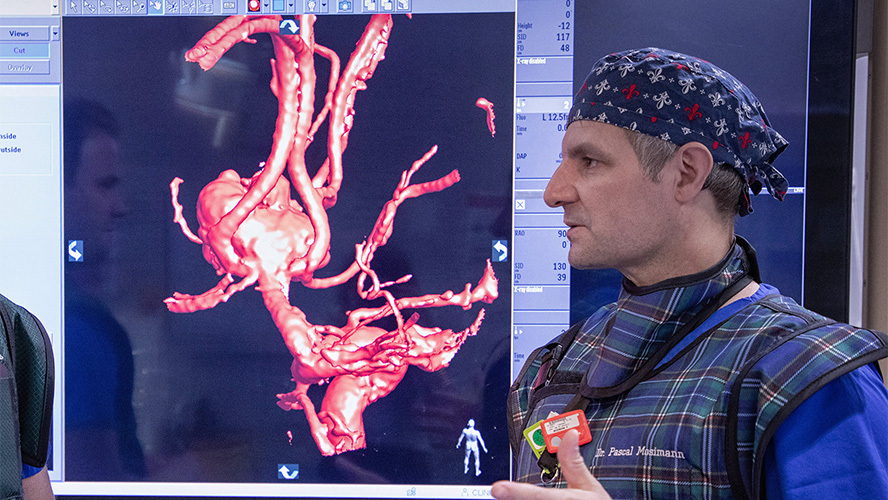
In a recent study published in Science Robotics, Dr. Pascal John Mosimann from UHN’s Krembil Brain Institute and his international team at the Swiss Polytechnic School in Lausanne (EPFL) developed a new catheter system that uses blood flow to reach very small brain blood vessels faster and more safely. This approach is the first to enable super-selective embolization—the delivery of a drug that blocks blood flow, called an embolic agent, to a targeted area—in vessels previously considered too small, deep, or tortuous for existing technologies.
Super-selective embolization involves guiding a very small catheter, called a microcatheter, through a blood vessel to deliver the embolic drug to a precise location, stopping blood flow. Until now, endovascular catheters could only be safely used in vessels a minimum of 0.5 millimetres (mm) wide—about as thick as a credit card—although many vessels requiring treatment measure 0.05–0.4 mm. Existing microcatheterization systems require physically pushing the catheter along the vessel walls, increasing the risk of vessel wall damage or perforation.
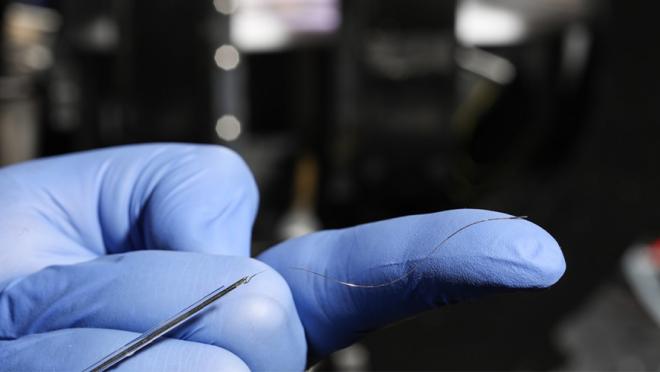
Using advanced engineering techniques, Dr. Mosimann and his team developed a new microcatheter system about as thin as a human hair called MagFlow. The system remains flat while it moves through the vessel and then inflates when a drug or other therapeutic agent is injected once it reaches the desired treatment location. MagFlow utilizes blood flow in the artery or capiliary that the catheter is in to move, eliminating the need for manual force and thus reducing the risk of injuring the blood vessel wall. A specialized external magnet, called OmniMag, can be moved around the outside of a patient’s head to assist with positioning of the catheter. Movement of the catheter is monitored via X-ray fluoroscopy.
Results from tests in preclinical models were promising. The novel MagFlow and OmniMag system could be safely and effectively guided and used for the injection of embolic drugs in vessels as small as only 0.18 millimetres—about as thin as a cat’s whisker.
This advancement could transform care for patients with aneurysms, strokes, brain tumours, and other complex vascular conditions. By enabling access to vessels previously considered unreachable, MagFlow opens the door to highly targeted therapies that minimize risk and maximize precision. Clinicians may soon be able to treat delicate brain regions with less trauma, offering safer interventions and expanding options for conditions that were once untreatable.
The first author of this study is Dr. Lucio Pancaldi, a former Postdoctoral Scientist at École polytechnique fédérale de Lausanne (EPFL) in Switzerland.
Dr. Pascal John Mosimann, a Clinician Investigator at UHN’s Krembil Brain Institute and Associate Professor of Neuroradiology at the University of Toronto’s Temerty Faculty of Medicine, and Dr. Mahmut Selman Sakar, an Associate Professor and director of the MicroBioRobotics Systems Laboratory at EPFL in Switzerland, are corresponding and senior co-authors of the study.
This work was supported by the European Research Council (ERC), Innosuisse, BRIDGE, Innogrant, the Swiss National Science Foundation, and UHN Foundation.
Drs. Pancaldi and Sakar filed patents for the ultraflexible flow-directed device and system, and another patent on the magnetic guide system.
Pancaldi L, Özelçi E, Gadiri MA, Raub J, Mosimann PJ, Sakar MS. Flow-driven magnetic microcatheter for superselective arterial embolization. Sci Robot. 2025 Oct 22;10(107):eadu4003. doi: 10.1126/scirobotics.adu4003.