



Home page Description:
Study shows how B cells impact age-related immune system decline and lifespan.

Posted On: January 29, 2026
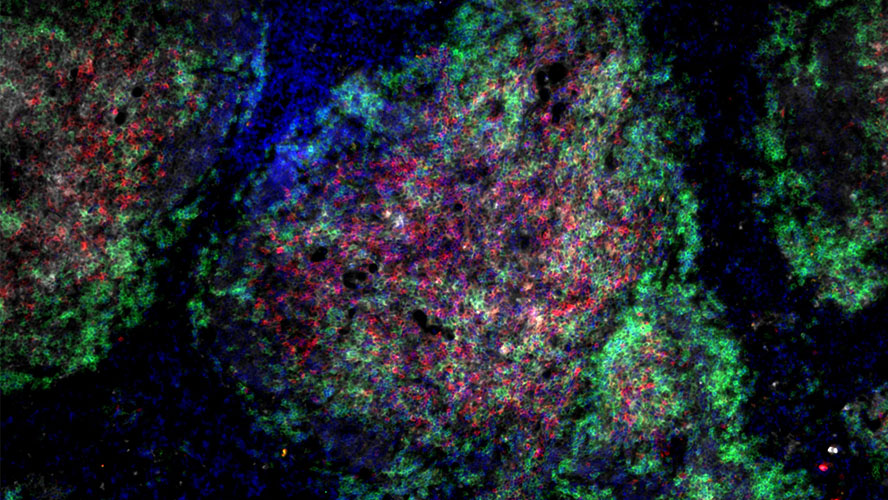
Image Caption:
Aging is one of the largest risk factors for most chronic diseases, including diabetes, heart disease and stroke, vulnerability to infection, and more. Decline in immune system function with age is a major contributor to these illnesses. In the spleen (pictured), T cells (red) and B cells (green) play crucial roles in the immune system responses, which are and compromised during aging. (Image: Winer lab)
The global population of individuals aged 65 years and older is rapidly increasing. As a result, age‑related health complications have emerged as some of the most pressing health care challenges of our time, with immune system decline playing a major role. In a new study, published in Science Immunology, researchers from UHN, in collaboration with the Buck Institute for Research on Aging, identified a key mechanism underlying why immune cells stop working properly with age.
A main contributor to the aging process is the development of chronic low-grade inflammation—a constant, mild activation of the immune system. This inflammation is linked to age-related health concerns such as increased susceptibility to infection and disease, and decreased survival of older populations. This inflammation, coupled with the reduced ability of the immune system to effectively respond to change, is a major hallmark of an aged immune system.
“Some of the most important cells of the immune system are called T cells, and these cells do not function properly to protect the body from infections with age,” says Dr. Dan Winer, Senior Scientist at UHN and co-senior author of the study. “When T cells show features of aging, it makes people vulnerable to infection, heart disease, cancer, and more. We therefore sought to better understand why T cell aging happens.”
Using preclinical lab models, the research team found that another type of immune cell, the B cell—important for producing antibodies—was required for T cell aging.
By mimicking a loss of B cells in these models, the researchers found that B cells contributed to age-related changes in the composition of T cells and deterioration in T cell function. When no B cells were present, there were more young, “naive” T cells and fewer mature, specialized, and exhausted T cells throughout the aging process. These naive T cells functioned like young cells, even into old age. The presence of B cells was also important for T cell activation states and inflammatory potential—all components of the normal T cell aging process.
“During the aging process, the presence of B cells, and more specifically, the communication between B and T cells, was required for the T cells to start aging,” says Dr. Saad Khan, co-first author of the study. “In addition, experimental models that lacked B cells showed marked improvements in lifespan and the amount of time spent in good health.”
Interestingly, B cells gained a stronger capacity to age T cells when their ability to respond to insulin signaling was active. This suggests that external factors, like blood sugar, could contribute to immune system aging and the associated decline in health parameters with age.
“These findings identify a leading mechanism driving immune system changes during aging—a process that sits center stage in facilitating many devastating diseases and impacts longevity,” adds Dr. Winer. “This work sets the stage for further study—providing the opportunity to try and build better immune systems as we get older.”
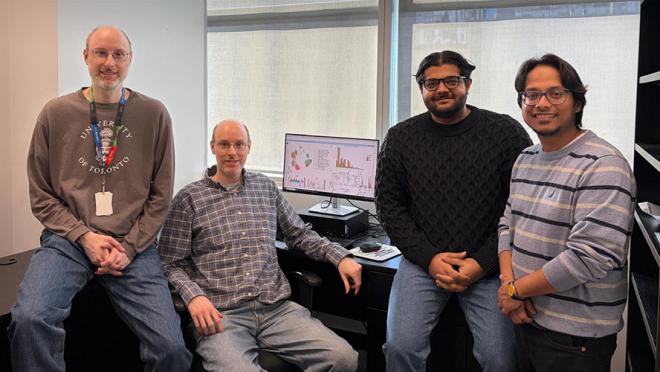
(L-R) Study co-authors Dr. Shawn Winer, Dr. Dan Winer, Dr. Saad Khan, and Mainak Chakraborty (Image: Dan Winer)
Dr. Saad Khan, former Scientific Associate at UHN and current medical student at Queen’s University is the co-first author of the study.
Mainak Chakraborty, a research technician at UHN, is co-first author of the study.
Dr. Shawn Winer, Assistant Professor in the Department of Laboratory Medicine and Pathobiology at the University of Toronto, is co-senior author of the study.
Dr. Dan Winer, Senior Scientist at UHN and Assistant Professor in the Department of Laboratory Medicine and Pathobiology, and the Department of Immunology at the University of Toronto, and Associate Professor at the Buck Institute for Research on Aging, is the corresponding author and co-senior author of the study.
This work was supported by the National Institutes of Health, the Canadian Institutes of Health Research, Sinai Health, the Natural Sciences and Engineering Research Council, the Canada Foundation for Innovation, the Government of Ontario, Norn Group, and UHN Foundation.
Khan S, Chakraborty M, Wu F, Chen N, Wang T, Chan YT, Sayad A, Kotlyar M, Alibhai FJ, Woo M, Li R‑K, Husain M, Jurisica I, Gehring AJ, Ohashi PS, Furman D, Tsai S, Winer S, Wine DA. B cells drive CD4 T cell immunosenescence and age-associated health decline. Sci Immunol. 2026 Jan 30. doi:10.1126/sciimmunol.adv7615.