Women Shaping Science at UHN
Inspiring stories of researchers, trainees, and support teams driving discovery and innovation.

On February 11, we mark the International Day of Women and Girls in Science by celebrating the women across UHN whose work drives health research and innovation forward. From principal investigators and trainees to administrators and support teams, their expertise, leadership, and dedication strengthen our collective pursuit of discovery for A Healthier World.
Join us in recognizing the remarkable women of TeamUHN whose contributions continue to shape the future of science.
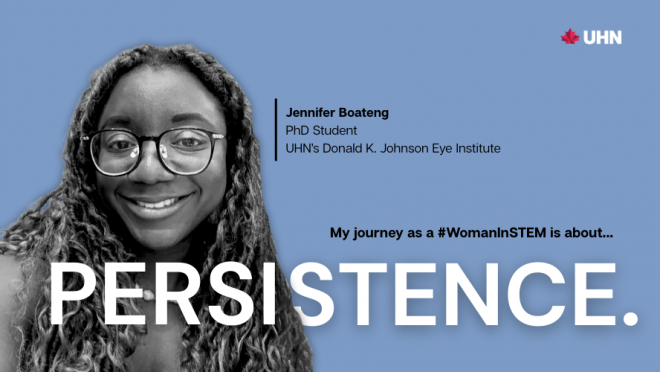
Jennifer Boateng | PhD Student at UHN’s Donald K. Johnson Eye Institute
Role at UHN
I am a fourth-year PhD student in the lab of Dr. Karun Singh at UHN’s Donald K. Johnson Eye Institute, where my research focuses on neuroscience, neurodevelopmental disorders, and autism.
What is one word that defines your journey in science, and how does it show up in your work or career?
Persistence.
Science is defined by failure as much as by discovery. Progress requires being comfortable with setbacks and staying motivated to move beyond them. When my experiments do not work, my curiosity and desire to answer my questions keep me moving forward. That same persistence has shaped my journey in research, pushing me to grow through challenges despite uncertainty.
What aspect of your work excites you the most, and how does it help advance UHN’s vision of A Healthier World?
What excites me most about my work is that we have access to innovative technologies that enable us to gain deeper insight into disease mechanisms. For example, in my lab, we use patient-derived stem cells to create brain organoids (lab-grown organ models) that help us to better understand disease onset and progression. Our research opens the door to precision medicine, where a patient's stem cells can be used to create individualized treatments.
What does it mean for you to be a woman in science?
Being a woman in science means representation and the responsibility of creating space for those who come after me. Scientific research has historically lacked Black women, and showing up confidently and doing meaningful work in this space can help challenge that absence and inspire others to follow similar paths. Being a woman in science also means gaining the tools to address issues that directly affect my community and using science to create lasting change.
How can we collectively create a more inclusive and supportive environment for women and girls in science?
To create a more inclusive environment, we need more mentorship programs to help girls early in their career learn how to successfully navigate the system. We also need support systems in place that enable women to focus on having families. Policies like maternity leave and childcare subsidies make it easier for women to confidently stay in science. I also think we must show how all kinds of women belong in science and that it is okay to be vulnerable and emotional.
If you could give one piece of advice to girls interested in STEM, what would it be?
Hold on to your ‘why’ and let that be what guides you. There will be many ups and downs, and there will be people who tell you that you do not belong in this space. In those moments, return to the passion and purpose that brought you to science in the first place. Your ‘why’ will be the anchor that keeps you moving forward.
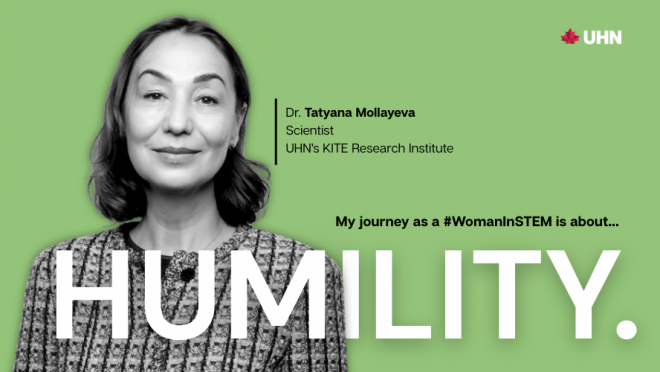
Tatyana Mollayeva | Scientist at UHN’s KITE Research Institute
Role at UHN
I am a scientist at UHN’s KITE Research Institute and lead the BRIDGE Lab, where we focus on equity‑driven research, education, and community engagement to advance brain health, particularly after traumatic brain injury.
What is one word that defines your journey in science, and how does it show up in your work or career?
Humility.
Humility has guided my lifelong path as a medical student, clinician, public health professional, researcher, and educator. It reminds me of how much I still have to learn, encourages me to ask questions, and fuels my curiosity. In my work and mentorship, humility helps me value diverse perspectives, fosters shared learning, and ensures our research remains patient‑centred, socially responsible, and grounded in equity.
What aspect of your work excites you the most, and how does it help advance UHN’s vision of A Healthier World?
I am most excited by research that focuses on prevention and equity across all stages of life. My work addresses early risk factors such as sleep and social determinants of health and uses clinical and population‑level data to inform policies and practices that can prevent injury, improve rehabilitation, and reduce long‑term burden. UHN’s vision of A Healthier World recognizes that equity and prevention are essential, not optional, and that deeply resonates with how I approach science every day.
What does it mean for you to be a woman in science?
Being a woman in science has deepened my sense of responsibility to those whose voices and experiences are often missing from research. The absence of evidence from historically underrepresented communities is not neutral—it signals who is seen and who remains invisible. I see it as my responsibility to ensure that this invisibility does not persist, and that science serves people across differences in gender, resources, and lived experience.
How can we collectively create a more inclusive and supportive environment for women and girls in science?
Creating supportive environments starts with early exposure and encouragement, showing girls that curiosity, persistence, patience, and creativity are just as valuable as speed or assertiveness. Within research settings, we must foster inclusive cultures that value collaboration, provide mentorship and sponsorship, and actively address barriers. Hands‑on experiences, community engagement, and peer networks help women and girls build confidence, resilience, and a sense of belonging in science.
If you could give one piece of advice to girls interested in STEM, what would it be?
Believe in yourself and your ideas—your curiosity and creativity matter. Be adaptable, ask questions, and don’t be afraid to challenge what you are told. Surround yourself with people who believe in you. Every step of learning makes you stronger and brings you closer to making an impact. Canada needs your vision and your talent, so go for it confidently and keep learning.
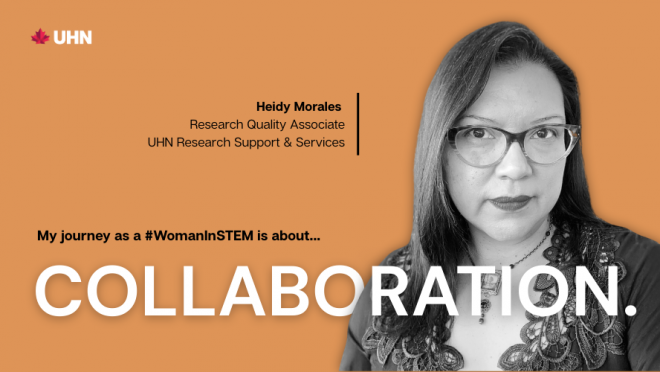
Heidy Morales | Research Quality Associate with the Research Quality Integration (RQI) department at UHN.
Role at UHN
I work in the Research Quality Integration (RQI) department at UHN as a Research Quality Associate. I have previously worked in clinical research programs across various academic centres in Toronto, including in the fields of psychology, psychiatry, adolescent medicine, and hepatology.
Within my current role, I work closely with investigators and research teams through consultations, training sessions, and support during regulatory inspections. Our team plays a key role in strengthening regulatory compliance and best practice standards across UHN.
What is one word that defines your journey in science, and how does it show up in your work or career?
Collaboration.
In scientific research, collaboration is key to driving change and propelling new discoveries. My work requires building strong relationships with a broad range of stakeholders, including colleagues, trainees, scientists, research staff, and senior leadership. This ongoing collaboration is what makes my work a learning and rewarding experience.
What aspect of your work excites you the most, and how does it help advance UHN’s vision of A Healthier World?
Being able to contribute to the development and communication of research best practices and delivering education and support that promotes ethical, safe, and high‑quality research across UHN are the most exciting aspects of my work.
I strongly believe that knowledge-sharing and capacity‑building within the research community not only benefits scientists but also our patients and their families.
What does it mean for you to be a woman in science?
Being a woman in science means being multifaceted. From direct patient care, lab work, or administrative work, to supporting clinical research, each of us works to advance scientific development.
Being a woman in science also means being motivated by a passion for making a difference and understanding how we can support each other to elevate our contributions—building and advocating for equity and diversity through the work we do every day.
How can we collectively create a more inclusive and supportive environment for women and girls in science?
Collectively, we can create opportunities for women and girls in science through advocacy and sponsorship. By creating open and safe spaces for women and girls to network and meet others with varying degrees of experience, we can demystify what it means to work in science.
For women already in the field, having access to flexible work environments, opportunities for ongoing education and professional growth, and having ‘a seat at the table’ where key decisions are made is key. Representation at all levels matters.
If you could give one piece of advice to girls interested in STEM, what would it be?
My advice would be to stay curious and inquisitive. Showing an interest in learning and engaging with others’ work will open many doors. Being part of STEM means cultivating an open mind and looking for opportunities to learn while at the same time asking questions that may lead to new, transformative initiatives.
I recommend finding areas in STEM that fuel your passion and keep you grounded—seeking those who share your passions to start conversations with. Science needs all of us.
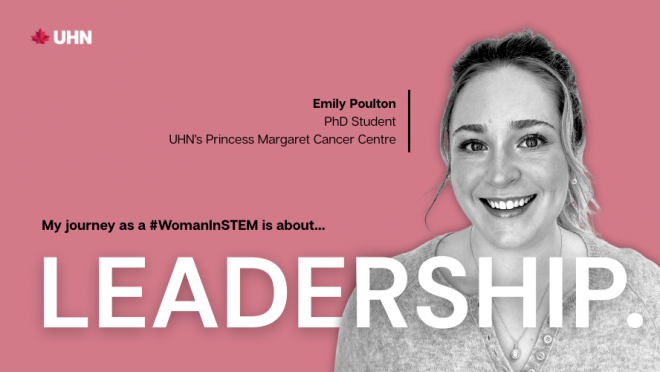
Emily Poulton | PhD Student at UHN’s Princess Margaret Cancer Centre
Role at UHN
I am a PhD student at UHN's Princess Margaret Cancer Centre in Dr. Marianne Koritzinsky’s lab. My research focuses on understanding how pancreatic tumours adapt and develop resistance to therapy, with the goal of identifying strategies that can improve treatment effectiveness and patient outcomes.
What is one word that defines your journey in science, and how does it show up in your work or career?
Leadership.
I was fortunate to be inspired early on by women in science, and that experience shaped how I approach my own career. I strive to pass that leadership and encouragement on to other women as they begin their research journeys, just as it was passed on to me.
What aspect of your work excites you the most, and how does it help advance UHN’s vision of A Healthier World?
What excites me most about research is that it continually challenges me to learn, think critically, and contribute to the broader scientific understanding of our world. Creating A Healthier World begins with understanding how biological systems function and how disease disrupts them. Our research focuses on overcoming pancreatic tumour resistance to therapies, with the goal of informing more effective treatment strategies in the future.
What does it mean for you to be a woman in science?
For me, being a woman in science means showing up with confidence and bringing my unique perspective into every space I enter. The women who came before us carved out opportunities through perseverance and hard work. It’s now our responsibility to continue pushing boundaries and redefining what women in science can achieve.
How can we collectively create a more inclusive and supportive environment for women and girls in science?
Early exposure to science and consistent encouragement play a major role in whether girls can envision science as a career. Supporting youth through meaningful engagement in scientific fields is essential, as is reinforcing that women are valued members of the workforce. These efforts help promote positive, inclusive experiences for women at UHN and beyond.
If you could give one piece of advice to girls interested in STEM, what would it be?
Stay persistent and do not back down. When doors don’t open, have the courage to open them yourself. You deserve to follow your passions and shape the life and career you envision. Simply showing up is already a powerful first step.
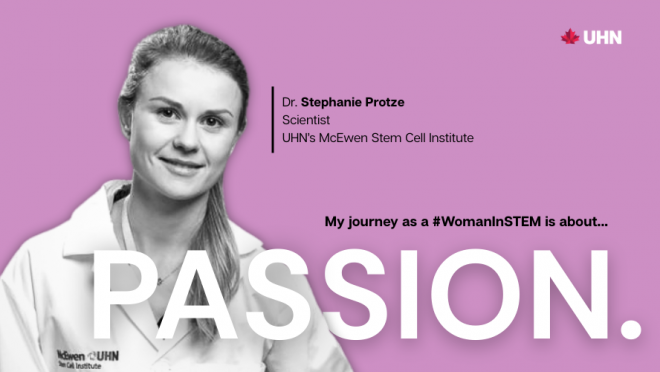
Dr. Stephanie Protze | Scientist at UHN’s McEwen Stem Cell Institute
Role at UHN
I am a Scientist working in regenerative medicine and cardiovascular research using human pluripotent stem cells (hPSCs).
What is one word that defines your journey in science, and how does it show up in your work or career?
Passion.
In my journey from undergraduate student to Principal investigator, I have consistently pursued what excites me and always worked with passion on research projects, which helped me accomplish my goals.
What aspect of your work excites you the most, and how does it help advance UHN’s vision of A Healthier World?
In my lab, we aim to harness the power of hPSCs to develop new therapies for cardiovascular disease. I am excited to work at the intersection of basic research and translation with the goal of bringing at least one of our stem cell-based therapies to the clinic during my career at UHN. These therapies will offer regenerative solutions and significantly improve treatment options, thereby contributing to UHN's vision of A Healthier World.
What does it mean for you to be a woman in science?
I am deeply grateful to my mentors who supported me throughout my career. As a woman and mother pursuing a scientific career, I appreciate living in an era that increasingly supports women, while recognizing that there is still work to be done. With that, I am committed to advancing and supporting the next generation of female scientists.
How can we collectively create a more inclusive and supportive environment for women and girls in science?
I strongly believe in the value of mentorship and in providing the tailored support that female trainees may need to thrive in their scientific careers, such as ensuring access to maternity leave and childcare. These supports benefit not only the trainee during important life transitions, but also their supervisor and the broader research team by maintaining continuity and stability within the laboratory.
If you could give one piece of advice to girls interested in STEM, what would it be?
My advice to young women interested in pursuing a career in STEM is to follow your passion and choose a path that truly inspires you. When you are driven by genuine interest, success naturally follows. I encourage you to seek out mentors and support networks that can guide you along the way—these relationships are invaluable to navigate challenges and reach your full potential.
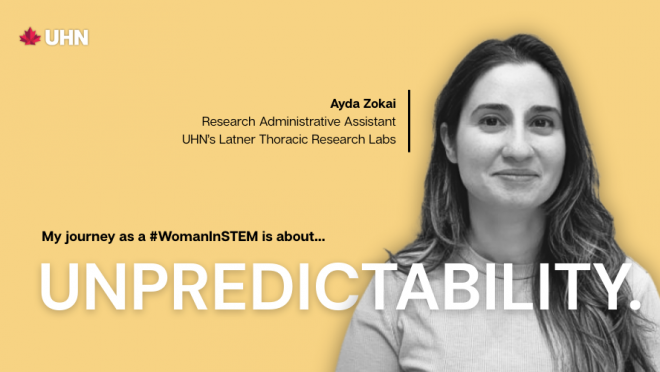
Ayda Zokai | Research Administrative Assistant at the Latner Thoracic Research Labs, UHN
Role at UHN
I am a Research Administrative Assistant in the lab of Dr. Marcelo Cypel at the Latner Thoracic Research Labs, UHN. I am also the co-lead of the AI and Big Data Sub-Committee within UHN's Research IDEA committee.
What is one word that defines your journey in science, and how does it show up in your work or career?
Unpredictable.
I could not have foreseen my career trajectory at UHN. From patient care to research, my path continued to evolve. Now, I have been given the ability to learn about IDEA (inclusion, diversity, equity, and accessibility) principles. I am grateful to my open and collaborative colleagues who brought me in and invested their time and energy to propel me forward.
What aspect of your work excites you the most, and how does it help advance UHN’s vision of A Healthier World?
Working on the Research IDEA Committee has become a passion project for me. I have had the opportunity to delve deeper into principles of justice, understand where gaps exist in the current health care system, and be inspired by the many ways we can continue to embed IDEA principles in all aspects of clinical and research processes. This work aligns with Research at UHN's commitment to “lead change towards an inclusive, diverse, equitable, and accessible (IDEA) research environment.”
What does it mean for you to be a woman in science?
It means providing a perspective that may not have been at the table otherwise. I have watched trainees come together in different ways to make sure women feel comfortable in male-dominated environments, and I have seen team building take on a different shape.
How can we collectively create a more inclusive and supportive environment for women and girls in science?
Through initiatives like UHN STEM Pathways, we can support and encourage a passion for STEM subjects from a young age. We can also create a more inclusive environment by maintaining an active focus on understanding and meeting the needs of women in our department. Sometimes, fostering belonging can be as simple as leaving space for those who have not spoken in a meeting. Seeing women bring their whole selves to the workplace and be honoured and uplifted is a huge point of inspiration to me.
If you could give one piece of advice to girls interested in STEM, what would it be?
It's okay to be seen and heard. Certain labs may be more male-dominated, but you have earned your place at the table just as they have. You are allowed to stand up straight during presentations and to ask questions and not apologize for it. Bring your unique self to the office—we are better for it.