




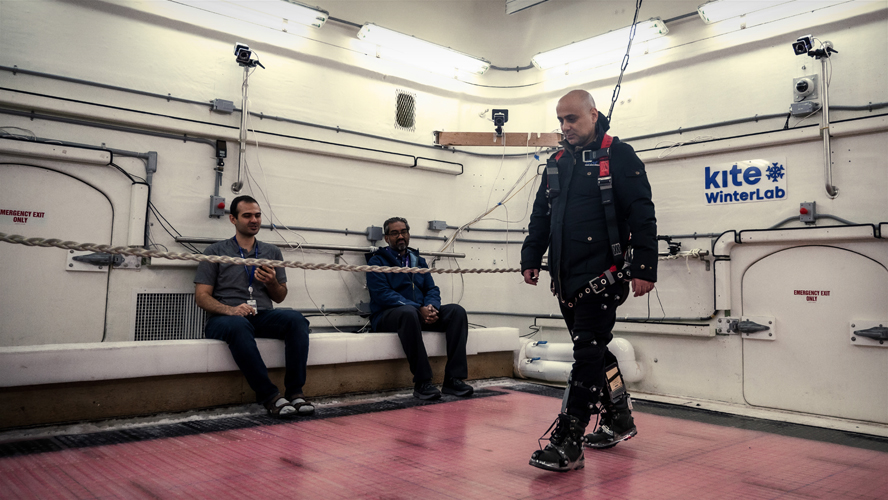
Slipping on ice is a major cause of winter injuries and a costly burden to the Canadian health care system. A new study from UHN’s KITE Research Institute shows that even top-rated winter boots cannot fully prevent slips, highlighting the need for additional safety measures.
As winter footwear design advances, researchers at the KITE Research Institute WinterLab evaluate slip resistance using a standardized test to measure how well boot sole technologies reduce the risk of slips and falls. Using a specialized platform that recreates winter conditions, researchers developed the Maximum Achievable Angle (MAA) test, which measures the steepest slope an individual can walk on without slipping. This provides a clear measure of slip resistance, but ice remains unpredictable and uniquely hazardous compared to other surfaces.
To better understand slip risk on icy surfaces, the research team recruited 27 participants to walk on an icy walkway while wearing a safety harness and 11 different winter boot models from popular brands, including Timberland, Merrell, and WindRiver. Boots were categorized as poor, moderate, or good slip resistance based on their original MAA score.
The results were striking. Analyzing over 8,500 steps, researchers found that nearly 12% resulted in a slip—approximately one slip every nine steps. Boots with poor ratings had a 36% slip risk, while even the highest rated boots still showed a 4–5% slip risk. Even advanced designs could not fully prevent slips.
These findings highlight that ice remains far more hazardous than most surfaces. While choosing boots with higher slip-resistance ratings is important, additional measures such as timely ice clearing, heated pavements, and safer walking techniques are needed to reduce winter injury.
This research group provides slip-resistance testing of winter footwear for manufacturers. Insights may inform the design of future commercial or service-based applications.
Davood Dadkhah, first author of the study, is a PhD candidate at UHN’s KITE Research Institute in the lab of Dr. Tilak Dutta.
Dr. Tilak Dutta, senior author of the study, is a Senior Scientist at UHN’s KITE Research Institute. At the University of Toronto, Dr. Dutta is an Associate Professor in the Institute of Biomedical Engineering and the Institute of Rehabilitation Sciences.
This work was supported by the Natural Sciences and Engineering Research Council of Canada and UHN Foundation.
Dadkhah D, Ghomashchi H, Dutta T. Determining the risk of slipping on level ice using winter footwear with varied maximum achievable angle slip-resistance performance. Appl Ergon. 2026 Feb. doi: 10.1016/j.apergo.2025.104678. Epub 2025 Oct 31.