Tracing the Genetics of Leukaemia-Initiating Cells

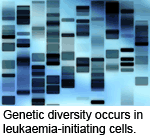 It has long been believed that cancer develops through multiple genetic alterations that accumulate over time in a single cell, and that all clones are linearly related to each other. However, a recent paper published in Nature by Dr. John Dick’s group, in collaboration with researchers at St. Jude Children’s Hospital, reveals a more complex, branching evolution model by demonstrating that individual patients harbour several genetically distinct leukemia-initiating subclones. As well, they show that diagnostic samples from these patients contain genetic abnormalities that influence the engraftment properties in xenografts and may be predictive of patient prognosis.
Cells from 20 patients with the disease Philadelphia chromosome acute lymphoblastic leukaemia (Ph+ ALL)—a single clinical entity with identifiable and recurrent genetic abnormalities—were engrafted into mice models of immune deficiency. Half the patient samples caused the disease to manifest in the mice within 15 weeks (group 1) while mice engrafted with the other half of the samples remained healthy (group 2). To explore the genetic basis of the differences between the two groups, the researchers performed genome-wide copy number alteration (CNA) profiling and found that a large proportion of group 1 samples had deletions of the tumour suppressor genes CDKN2A/B and PAX5.
To address whether Ph+ ALL evolves via a branching evolution model, paired CNA analysis of patient samples at diagnosis and after transplant in xenografts was performed. Interestingly, multiple xenografts from six individual patient samples contained divergent genetic abnormalities compared to the primary sample, indicating the presence of genetically distinct subclones in the primary diagnostic sample at very low levels. To examine the evolutionary process of the development of these subclones, the group compared the CNA analysis from these multiple xenografts and from this they were able to determine which genetic abnormalities occurred as early events in the pathogenesis of the disease, and which occurred later, and found that tumour clones undergo divergent evolution from the original diagnostic clone.
This data helps explain why some cancer cells may be resistant to chemotherapy and points towards the need to develop more effective therapies to eliminate all genetic subtypes of the cancerous cells.
Evolution of human BCR-ABL1 lymphoblastic leukaemia-initiating cells. Notta F, Mullighan CG, Wang JC, Poeppl A, Doulatov S, Phillips LA, Ma J, Minden MD, Downing JR, Dick JE. Nature. 2011 Jan 20. [Abstract]
Honouring the Fathers of Stem Cells on the 50th Anniversary of Their Discovery
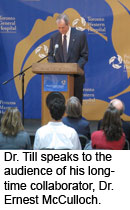 On February 1, 2011, UHN paid homage to the “fathers of stem cell science”, OCI researchers Dr. James Till and the late Dr. Ernest McCulloch, marking the 50th anniversary of the publication of their groundbreaking discovery of blood-forming stem cells. Also on this occasion, UHN honoured the memory of Dr. McCulloch, who passed away on January 20, 2011.
The event included tributes to the two esteemed researchers and their exceptional research discoveries through speeches and video, which you can view here.
McEwen Researchers Elected as Fellows to AAAS
 Congratulations to Drs. Molly Shoichet and Freda Miller who were elected as Fellows to the American Association for the Advancement of Science, in recognition for their meritorious efforts to advance science or its applications. Dr. Shoichet was honoured for her efforts in engineering, and Dr. Miller for her achievements in neurosciences. They will be recognized at the Fellows Forum during a ceremony at the annual AAAS meeting on February 19.


Stage-specific optimization of Activin/Nodal and BMP signaling promotes cardiac differentiation of mouse and human pluripotent stem cell lines.
Kattman SJ, Witty AD, Gagliardi M, Dubois NC, Niapour M, Hotta A, Ellis J, Keller G. Cell Stem Cell. 2011 Feb 4. [Abstract]
a3(V) Collagen is critical for glucose homeostasis in mice due to effects in pancreatic islets and peripheral tissues. Huang G, Ge G, Wang D, Gopalakrishnan B, Butz DH, Colman RJ, Nagy A, Greenspan DS. J Clin Invest. 2011 Jan 10. [Abstract]
Outcomes of patients with cystic fibrosis undergoing lung transplantation with and without cystic fibrosis-associated liver cirrhosis. Nash EF, Volling C, Gutierrez CA, Tullis E, Coonar A, McRae K, Keshavjee S, Singer LG, Durie PR, Chaparro C. Clin Transplant. 2011 Jan 28. [Abstract]
Stage-specific signaling through TGF{beta} family members and WNT regulates patterning and pancreatic specification of human pluripotent stem cells. Nostro MC, Sarangi F, Ogawa S, Holtzinger A, Corneo B, Li X, Micallef SJ, Park IH, Basford C, Wheeler MB, Daley GQ, Elefanty AG, Stanley EG, Keller G. Development. 2011 Jan 26. [Abstract]
Treatment of the elderly when cure is the goal: the influence of age on treatment selection and efficacy for stage III non-small cell lung cancer. Coate LE, Massey C, Hope A, Sacher A, Barrett K, Pierre A, Leighl N, Brade A, de Perrot M, Waddell T, Liu G, Feld R, Burkes R, Cho BC, Darling G, Sun A, Keshavjee S, Bezjak A, Shepherd FA. J Thorac Oncol. 2011 Jan 20. [Abstract]
Evolution of human BCR-ABL1 lymphoblastic leukaemia-initiating cells. Notta F, Mullighan CG, Wang JC, Poeppl A, Doulatov S, Phillips LA, Ma J, Minden MD, Downing JR, Dick JE. Nature. 2011 Jan 20. [Abstract]
The human syndrome of dendritic cell, monocyte, B and NK lymphoid deficiency. Bigley V, Haniffa M, Doulatov S, Wang XN, Dickinson R, McGovern N, Jardine L, Pagan S, Dimmick I, Chua I, Wallis J, Lordan J, Morgan C, Kumararatne DS, Doffinger R, van der Burg M, van Dongen J, Cant A, Dick JE, Hambleton S, Collin M. J Exp Med. 2011 Jan 17. [Abstract]
Increased levels of interleukin-1ß and tumor necrosis factor-a in donor lungs rejected for transplantation. Cypel M, Kaneda H, Yeung JC, Anraku M, Yasufuku K, Perrot MD, Pierre A, Waddell TK, Liu M, Keshavjee S. J Heart Lung Transplant. 2011 Jan 14. [Abstract]
Surgical management of cervical spine manifestations of neurofibromatosis Type 1: long-term clinical and radiological follow-up in 22 cases. Taleb FS, Guha A, Arnold PM, Fehlings MG, Massicotte EM. J Neurosurg Spine. 2011 Jan 14. [Abstract]
Functional and clinical outcomes following surgical treatment in patients with cervical spondylotic myelopathy: a prospective study of 81 cases.
Furlan JC, Kalsi-Ryan S, Kailaya-Vasan A, Massicotte EM, Fehlings MG. J Neurosurg Spine. 2011 Jan 14. [Abstract]


The McEwen Centre for Regenerative Medicine, led by director Dr. Gordon Keller, includes 15 scientists at the University of Toronto and five Toronto hospitals, working to advance the development of more effective treatments for conditions including heart disease, diabetes, respiratory disease and spinal cord injury.
The Centre is located at University Health Network, MaRS Centre, Toronto Medical Discovery Tower, 101 College Street, 8th Floor, Room 701, Toronto, Ontario, Canada M5G 1L7
Email: mcewencentre@uhn.on.ca
Feedback/To Unsubscribe
McEwen Monthly is brought to you by the McEwen Centre for Regenerative Medicine and UHN Research Communications. We hope you have enjoyed receiving this message. If you have any feedback, or if you would prefer to receive the newsletter in text format, please email shelley.brown@uhnresearch.ca.
Some images adapted from the image archives of stock.xchng.ca or NIH Image Bank